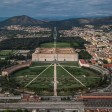
In the Calatino area of eastern Sicily sits a town laid out in a perfect hexagon, founded in the 17th century and still remarkably intact. It is instantly recognisable from above: its geometric street grid forms a precise hexagon that feels almost hypnotic. And this isn't a modern experiment, but the result of a rigorous urban vision dating back to the 1600s.
With just over 12,000 residents, find out what to see in Sicily’s hexagonal town.
1693: from earthquake ruins to an ambitious urban plan
Grammichele, in Catania, is like nowhere else. Everything began after the devastating earthquake of 1693, which destroyed large parts of the Val di Noto and wiped out the old town of Occhiolà.
To rebuild the town, an entirely new urban layout was designed by architect Michele da Ferla, commissioned by Prince Carlo Maria Carafa Branciforti. The first stone of the new town was laid just three months after the disaster, in an effort to provide survivors with an ordered and liveable settlement as quickly as possible.
The hexagonal plan was not conceived as an aesthetic whim but as a functional solution, intended to organise space, movement and sightlines in a rational way.
Today, the prince’s statue stands in the main square, a reminder of the decision that transformed tragedy into an urban experiment comparable to other post-earthquake reconstructions in eastern Sicily.
What to see in the historic centre
The historic centre is the focal point of any visit, where strict geometry meets Sicilian Baroque architecture. The rhythm of streets and open spaces naturally guides you towards the town’s central hub.
Piazza Carlo Maria Carafa and the sundial
The square named after the prince forms both the geometric and civic centre of Grammichele. Six main streets radiate outwards, defining the hexagon.
At the centre stands a large sundial marking the date and time, underlining the town’s ongoing dialogue with light and geometry. It is accompanied by six additional sundials placed in small squares along the principal axes.
The Baroque churches along the axes
Among the religious buildings, the Church of San Michele Arcangelo stands out. Its Baroque façade and richly decorated interiors reflect the ambition behind the reconstruction.
The Mother Church, dedicated to Saint Catherine of Alexandria and Saint Michael the Archangel, also deserves attention. Its scale and placement reinforce the careful balance between religious architecture and geometric order.
The museum and the original slate plan
The Paolo Orsi Civic Archaeological Museum houses a key document: the original slate tablet on which Michele da Ferla engraved the plan of Grammichele.
The museum also displays artefacts tracing the earlier phases of settlement in the area, linking the former town to the rebuilt one. The exhibition helps explain the historical layers behind the town’s strict geometry, connecting practical considerations with symbolic ambitions.
Occhiolà, the town before the earthquake
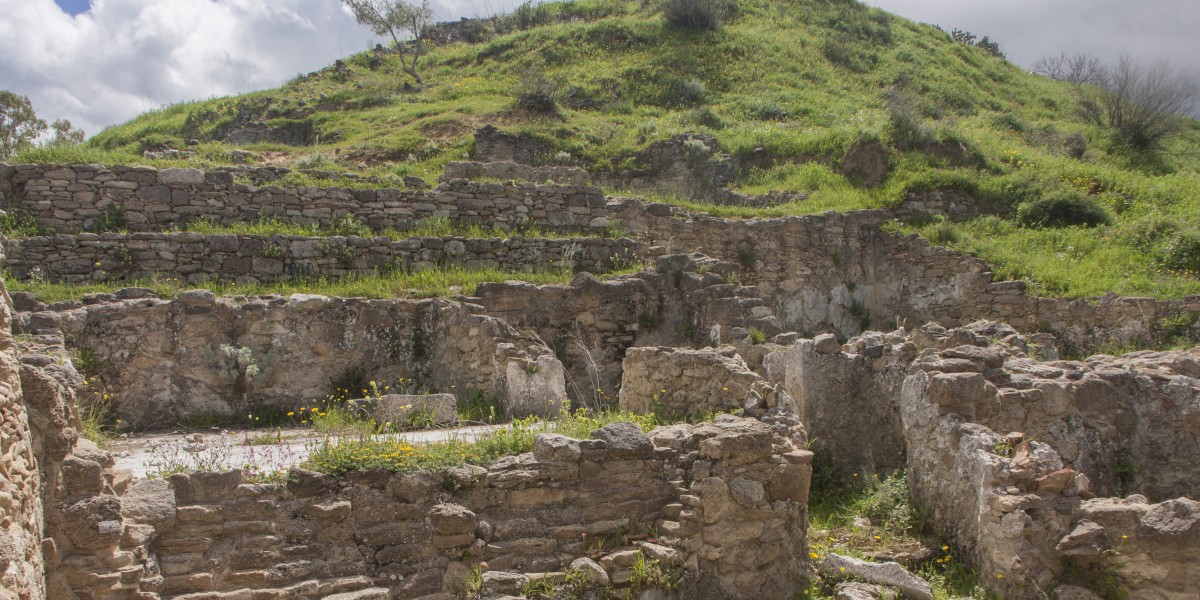
A short distance from Grammichele lies the archaeological site of ancient Occhiolà, set in a natural setting overlooking the valley. The site, which can be visited by appointment, preserves evidence of habitation dating back to the Bronze Age until the earthquake that marked its end.
Some finds, including terracotta figurines, are displayed in the Civic Museum, creating a direct link between the pre-earthquake settlement and the new hexagonal town.
How to get there and getting around
Grammichele is around 65 kilometres from Catania, the main gateway to eastern Sicily.
- By car: SS417 from Catania towards the south-west, then SP33 near the town.
- By train: regional Catania–Caltagirone line, Grammichele stop, roughly 1h30.
Often described as Italy’s most photographed geometric town, Grammichele gives the impression that every corner was drafted with mathematical precision.
Article based on "La città geometrica più fotografata d’Italia" by Turisti per Caso
Stay inspired for your travels in Italy —get our weekly newsletter for the latest travel, legal, and lifestyle news.