Step into this tiny village that feels as though it has slipped out of a fairy tale. This small hamlet in Marche is one of those places that forces you to slow down.
The Italian village is nicknamed “Little Tibet” because of its isolated position and the sweeping views that suddenly open out over the valley below.
- Where Elcito is and why it’s called “Little Tibet”
- How to get to Elcito and where to park
- What to see in Elcito: the village of silence
- Panoramas, nature and a particular name
- Walking trails between Elcito, Valfucina and Canfaito
- Lingering legends: the fountain of the washerwoman-witches
- Places to visit nearby
Where Elcito is and why it’s called “Little Tibet”
Elcito stands on a rocky spur at around 821 metres above sea level, on the slopes of Monte San Vicino. It sits within the Monte San Vicino and Canfaito nature reserve in the province of Macerata.
Its reputation comes from its suspended position and the dramatic panorama: rounded hills, meadows and woodland spread out beneath the stone houses. On clear nights, the absence of artificial light reveals a star-filled sky that surprises even those familiar with the Apennines.
How to get to Elcito and where to park
To reach Elcito, head from the centre of San Severino Marche towards Apiro. Pass through the hamlet of Castel San Pietro before following a narrower road that climbs in tight hairpin bends to the village. The final stretch is winding and, in winter, can mean snow, ice or sudden fog.
Access to the historic centre by car is generally reserved for residents. There are a few spaces near the local refreshment point, but more often visitors park along the roadside, on the grass, around 200–300 metres from the entrance.
What to see in Elcito: the village of silence
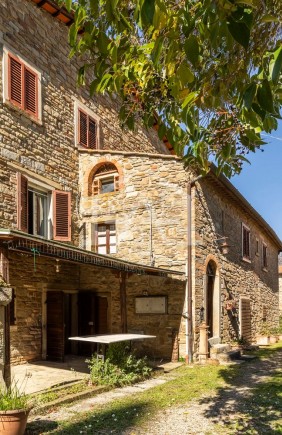
Entering on foot, you arrive at a small square overlooked by the Church of San Rocco. It is built in the area where a medieval castle once stood. Traces of the old defensive structure remain in the compact layout of the village, with stone houses pressed tightly together like a single protective wall.
A small open-air “museum” of black-and-white photographs displayed on the walls brings back the faces, trades and festivals of half a century ago, when these streets were still full of life.
Panoramas, nature and a particular name
Looking out over the edge of the cliff, the view encompasses the Canfaito plateau with its monumental beech trees and the rounded profile of Mount San Vicino.
Below, the scattered houses of Valfucina mark the site of the ancient abbey; in the distance, the San Clemente Valley leads toward Apiro.
The name Elcito recalls the historical presence of holm oaks in the surrounding woods, a sign of forests that have partly given way to pastures and beech forests.
Walking trails between Elcito, Valfucina and Canfaito
Elcito is also an excellent starting point for walkers. A marked circular hiking route (graded E for hiking difficulty) links Valfucina with the beech forest of Canfaito and the peaks of Monte Faldobono and Monte la Pereta.
The route covers roughly 12 kilometres, with 700 metres of elevation gain, and takes about four hours on average
There is also a shorter option, descending towards the remains of the Abbey of Santa Maria in Valfucina and continuing to the Canfaito monument.
Lingering legends: the fountain of the washerwoman-witches
Local folklore around Elcito includes tales of witchcraft.
One story speaks of washerwoman-witches who gathered at a nearby spring, referred to as Fonte dei Tarocchi. According to legend, a shepherd managed to save himself thanks to straps made of dog leather, believed to be intolerable to witches.
Today these stories add a faint sense of mystery to evening walks and encourage visitors to look more closely at rocks and pathways for traces of the old folklore.
Places to visit nearby
With a bit of time, it’s easy to build a themed itinerary among abbeys, hermitages and characterful villages in the surrounding area:
- Abbey of Sant’Urbano, famous for the phenomenon known as the “Eye of Sant’Urbano”, visible on two specific dates each year.
- Abbey of Sant’Elena, set in the green countryside inland.
- Eremo dei Frati Bianchi in Cupramontana, with caves carved directly into the rock.
- Braccano, a village decorated with murals.
- Castello di Precicchie, a medieval structure in a commanding hilltop position.
- The Leaning Tower of Cerreto d’Esi, an unusual historic curiosity off the usual tourist routes.
Article seen on The Wom: Sembra il Tibet ma siamo nelle Marche (in italian).
Stay inspired for your travels in Italy —get our weekly newsletter for the latest travel, legal, and lifestyle news.