In Porto Venere, it only takes a few steps to go from the cool shade of narrow alleyways to the bright light along the cliffs. The landscape here is unlike anywhere else in Liguria: just offshore lie Palmaria, Tino and Tinetto, recognised together with the village as a UNESCO World Heritage Site.
The result is a place where history and long-held traditions sit alongside remarkably clear waters, protected by the Marine Protected Area.
Historic heart: medieval gate, alleyways and a seaside fortress
You enter the historic centre of this UNESCO-protected village through the Porta del Borgo, a 12th-century stone arch that opens onto a tangle of narrow lanes. Just beyond it runs Via Capellini, the village’s main artery, lined with tall, slender tower houses and the lingering scent of freshly baked focaccia drifting out of doorways.
Following the arches and steep stairways uphill, you arrive at Doria Castle, a Genoese fortress with an irregular layout shaped by the rocky headland. From its terraces, the view stretches across the entire Gulf of Poets, taking in the Apuan Alps and the three islands just offshore. Below, the Church of San Lorenzo safeguards the image of the White Madonna, at the heart of an annual night-time celebration when the village glows with candles and torchlight.
Postcard landscape: San Pietro and Byron’s Cave
The Church of San Pietro, set on a rocky spur that juts out into the sea, is impossible to miss. Construction began in 1198 on the remains of an earlier temple dedicated to Venus Ericina, and it stands out for its distinctive black-and-white striped façade, as well as floors worn and weathered by salt and sea winds.
At the foot of the church is the Arpaia Cave, better known as Byron’s Cave: a deep, shadowy inlet where people dive from the smooth rock ledges into clear water below. According to local legend, the English poet swam across the gulf to Lerici to visit his friend Shelley. Romantic myth or not, the setting still carries a distinctly literary feel.
Where to swim: clear water all around
There aren’t any long sandy beaches here. Instead, expect rocky cliffs, pebbles and small stretches of gravel tucked between headlands.
Swimming in the village
For a quick dip between strolls, head to the waterfront access points at Calata Doria and Piazzetta Bastreri. The bathing area is small, but it’s right by the centre and easy to reach. Carry on along the seafront, and you’ll come to Olivo Beach, a strip of pale pebbles with particularly clear water and a small pier that locals use for diving.
If you’re arriving from La Spezia, just before reaching the historic centre, you’ll find Mirella Beach. It’s larger and more open to the public, with a pebbly seabed and often very transparent water.
Palmaria: the island just offshore
A short boat ride separates Porto Venere from Palmaria, the only island in the archipelago that’s open to visitors. The beaches here are more varied. Close to the landing point, Punta Secco (also called del Secco) is broad and relatively easy to access, with both private lidos and free sections.
On the opposite side of the island, a footpath through Mediterranean scrub leads to Pozzale Beach, where smooth pebbles meet water that shifts between green and turquoise depending on the light. It can also be reached by taxi boat, though the walk back up is fairly steep. Even more tucked away is Cala Fornace (or La Maiella), a small cove of pale pebbles framed by rocky cliffs.
Local flavours: Gulf mussels, focaccia and seaside aperitifs
The cooking here is straightforward and centred firmly on the sea. In the restaurants around Calata Doria and along the lanes further inland, you’ll regularly see sea bream, sea bass and octopus on the menu. However, it’s the local mussels— farmed in the Gulf of Poets — that really define the area. They’re served alla marinara, stuffed, baked al gratin, or folded through pasta sauces.
For something quick at lunchtime, the local focaccerie turn out thin trays of well-oiled focaccia, sometimes topped or filled with cheese, vegetables or anchovies.
Which villages are closest to Porto Venere?
Just around the headland, Baia delle Grazie pairs a small harbour with a hilltop sanctuary overlooking the water. A little further along, the Roman Villa of Varignano still preserves its ancient olive oil production area, with original floors clearly visible.
Across the gulf are Lerici, San Terenzo and Tellaro, along with the beaches of Fiascherino, all reachable by boat or by road.
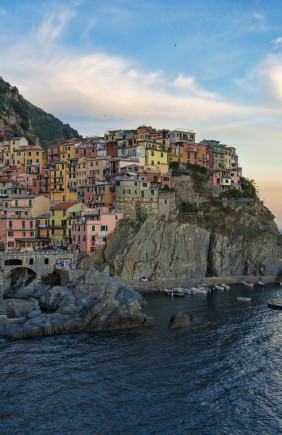
Porto Venere also works well as a base for visiting the Cinque Terre. During the season, boats run directly to Riomaggiore, Manarola, Corniglia, Vernazza and Monterosso, with the added bonus of seeing the coastline from the water rather than arriving by train.
Stay inspired for your travels in Italy —get our weekly newsletter for the latest travel, legal, and lifestyle news.