Italy is a country where every village and town has its own unmistakable story. Sometimes this is reflected in its traditions or monuments; in other cases, the uniqueness begins with the very layout of the town itself. Across the country, you’ll find a number of “ideal towns” designed entirely from scratch with geometric or unusual shapes. Scattered across the Italian peninsula, here’s where to find Italy’s geometric towns.
Palmanova
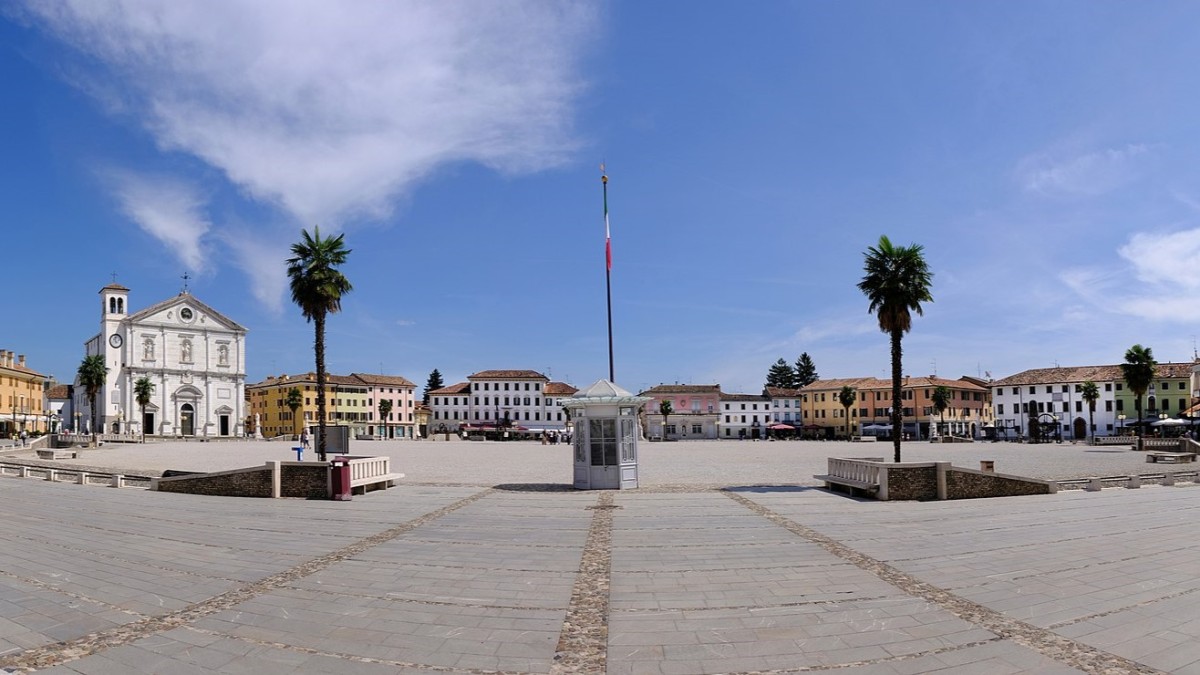
Palmanova is one of the most striking examples of a star-shaped town, designed and built at the end of the 16th century. Its nine-pointed star layout was created to serve as an impenetrable fortress while embodying the Renaissance dream of an ideal city. This perfect geometric design was not only strategic for defence but also reflected a rational urban model. For this reason, it has been recognised as a UNESCO World Heritage Site in Friuli Venezia Giulia.
Looking at the town from above or on a map, you’ll notice how the heart of Palmanova is defined by Piazza Grande, from which the main streets radiate towards the various bastions. Each segment of the town was planned to ensure a balanced distribution of space and easy accessibility. While in town, it’s worth visiting the Town Hall, the Historical Military Museum and Palmanova’s Baroque Cathedral.
Locorotondo
Amid the rolling countryside of Puglia lies the beautiful town of Locorotondo, an architectural gem whose name itself hints at its distinctive circular shape. The historic centre is laid out in a perfect circle, with winding alleyways spiralling around the town’s main church.
Ranked among the most unique places to visit in Puglia, Locorotondo is home to the Church of San Giorgio, Piazza Vittorio Emanuele, one of the town’s main squares, and the elegant Palazzo Morelli. After exploring the historic centre, it’s worth venturing out a little to find the perfect spot to photograph this white town from a distance.

Cittadella di Alessandria
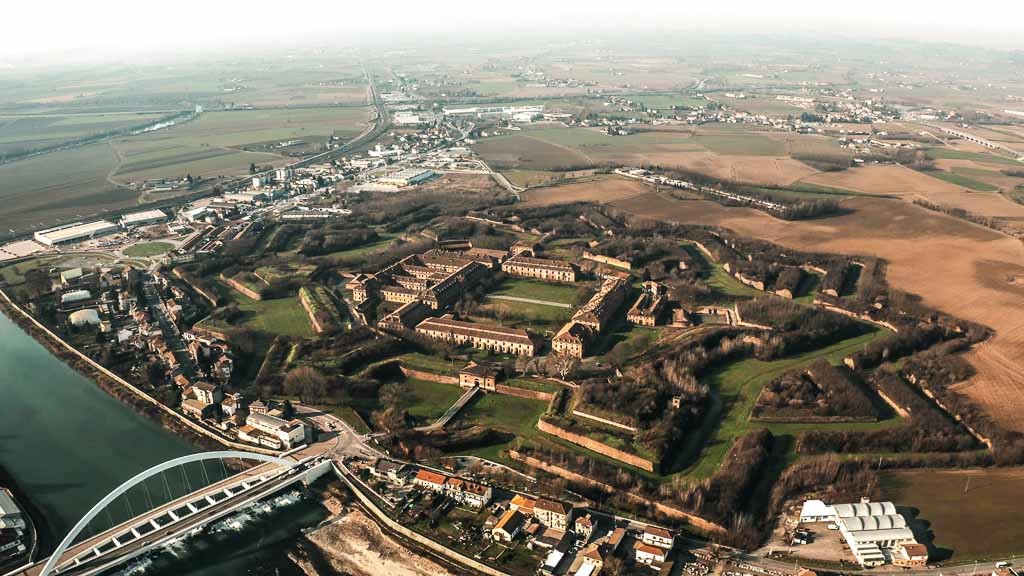
While not a town in the traditional sense, the Cittadella di Alessandria was designed to be independent and self-sufficient. Built in the mid-18th century for military purposes, it was created as an unassailable fortress incorporating the most advanced defensive techniques of the era.
Similar to Palmanova, the fortress is star-shaped, surrounded by greenery and countryside. If you have the chance to visit on open days, it’s well worth exploring its historic structures, some of which have stood for centuries. The site also hosts a range of events that attract visitors from the surrounding area.
Belpasso
In the province of Catania lies Belpasso, a town originally founded in Roman times but later rebuilt in 1669 after a powerful eruption of Mount Etna, and again in 1693 following a devastating earthquake. The town was relocated to its current site and named Stella Aragona.
The town’s centre is designed like a giant chessboard, with blocks intersecting at right angles. Highlights to visit include the Church of Santa Maria Immacolata, several historic churches, and the Cisterna della Regina, the only remaining part of Queen Eleanor of Anjou’s former residence.
Grammichele
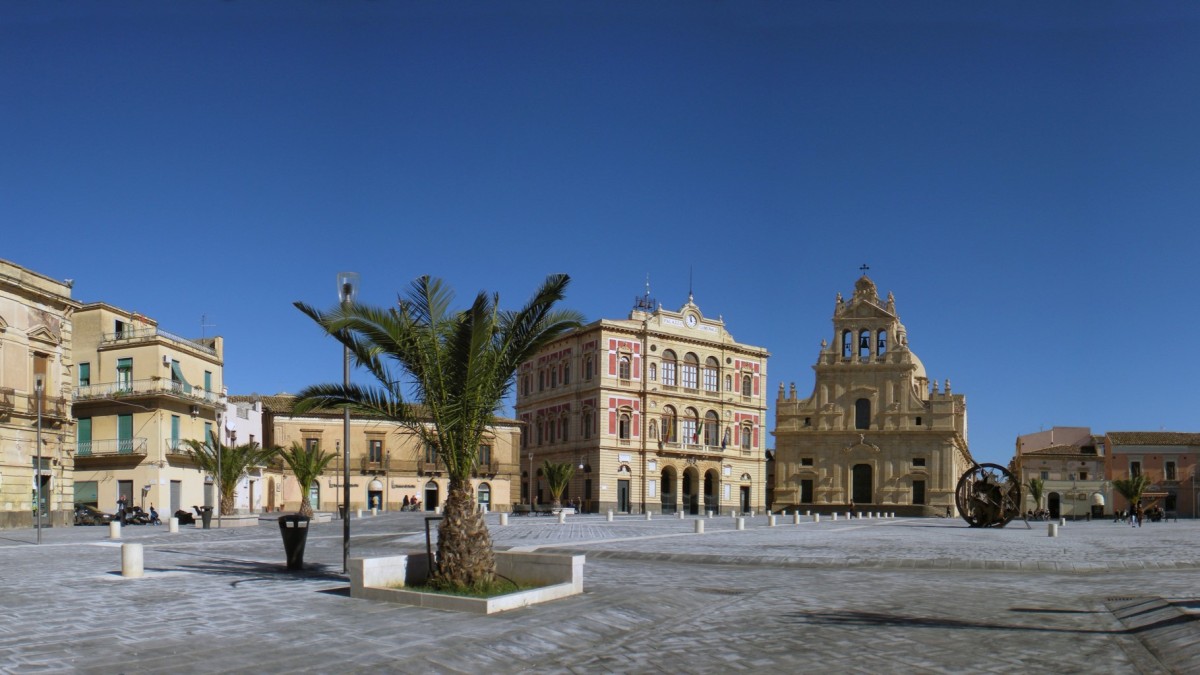
Also located in the province of Catania, Grammichele is a rare example of a hexagon-shaped town in Sicily. Founded in 1693 after an earthquake destroyed the ancient town of Occhiolà, it was rebuilt with a unique hexagonal plan, reflecting the ideals of perfection and harmony of the time.
At the heart of Grammichele lies its hexagonal main square, from which the town’s streets radiate outward, dividing it into six sectors. Key sights include the Church of San Michele Arcangelo and the Civic Archaeological Museum, which houses a fascinating collection of Greek and Roman artefacts.