Rail infrastructure across the European Union is undergoing a quiet transformation — and the changes could have long-term consequences for mobility, sustainability and even property markets in Italy.
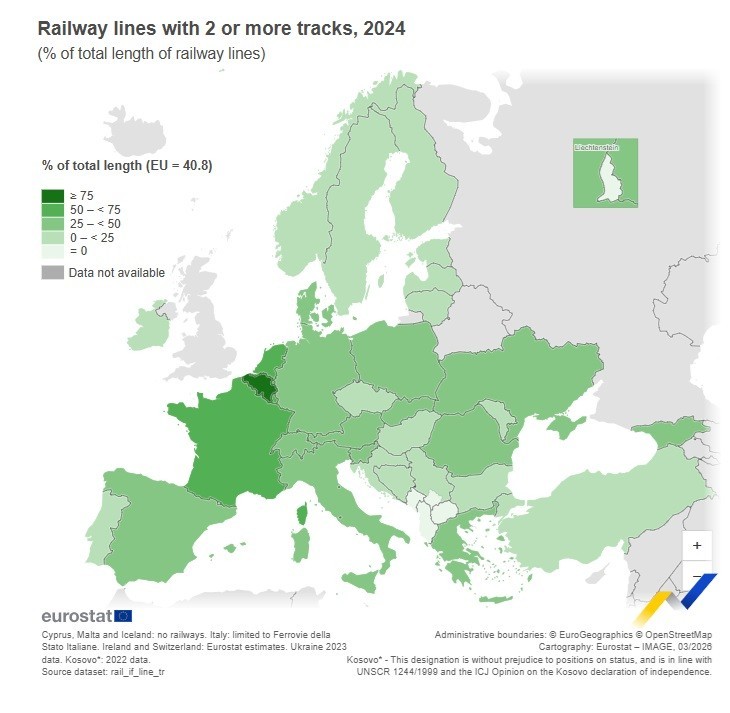
New data from Eurostat shows that in 2024, 40.8% of the EU’s railway network had two or more parallel tracks. That’s a significant improvement from 31.8% in 1990. More tracks mean fewer bottlenecks, improved safety and greater resilience when disruption occurs.
But there’s another shift that matters even more.
Electrification is accelerating across Europe
While the total length of the EU rail network has actually fallen by 8.7% since 1990 — now standing at just over 201,000 kilometres — the share of electrified lines has surged.
In 1990, only 39.9% of EU railway lines were electrified. By 2024, that figure had climbed to 57.6%.
For Italy, this trend is particularly relevant. With one of Europe’s most extensive high-speed rail networks, electrification is central to reducing emissions, improving journey times and supporting the country’s broader sustainability targets. Investment in rail is also closely linked to urban regeneration, especially around major stations in cities such as Milan, Rome, Bologna and Naples.
Which EU countries have the densest rail networks?
Rail density varies sharply across Europe.
In 2024, the Czech Republic had the highest railway density, with 123.2 metres of track per square kilometre. Belgium and Germany followed closely behind.
At the other end of the spectrum are Greece, Finland and Sweden, where rail networks are far less dense — largely due to geography and lower population density.
Italy sits somewhere in the middle of the European ranking, but its strength lies in connectivity between major urban centres. The north–south high-speed spine has reshaped domestic travel patterns and reduced reliance on short-haul flights — a structural shift that continues to influence regional development and housing demand.
The technology gap: who is leading on rail safety?
Beyond tracks and electrification, digital signalling is becoming a crucial factor.
The European Train Control System (ETCS) is designed to reduce collision risks by transmitting signals directly to trains via infrastructure or radio systems.
According to the European Union Agency for Railways, Luxembourg is currently the only EU country with its entire rail network equipped with ETCS. Belgium and Denmark are well advanced.
However, several major economies, including Germany, remain at relatively low levels of deployment.
For Italy, expanding ETCS coverage is vital. The country’s busy passenger corridors and growing freight demand mean that modern signalling is essential not only for safety, but for network efficiency and cross-border integration.
Why this matters for Italy
Rail infrastructure is no longer just a transport story.
In Italy, proximity to high-speed stations has already influenced property values, commuter behaviour and investment decisions. As Europe pushes forward with electrification and digital rail systems, cities that are well connected — both domestically and internationally — are likely to see continued economic advantages.
The real question for 2026 and beyond is whether infrastructure investment will keep pace with demand.
Because in Europe’s next growth cycle, connectivity may prove to be one of the most valuable assets of all.