Work eligible for tax relief falls into four main categories set out by law: extraordinary maintenance, restoration and conservative renovation, building renovation, and measures for safety, efficiency and accessibility. To establish which renovation works qualify for tax deductions in Italy in 2026, it is enough to check that the project falls within one of these legal categories.
Eligible work therefore includes upgrading technical systems, reinforcing load-bearing structures, demolition and reconstruction with the same volume, changing a property’s permitted use, installing photovoltaic or burglar-alarm systems, removing architectural barriers, asbestos removal and seismic improvement work.
What is included in the 2026 renovation bonus?
The main reference point for improving residential property in Italy remains the 2026 renovation bonus (bonus ristrutturazione 2026). The Italian Revenue Agency (Agenzia delle Entrate) has published its official guidance, setting out the criteria and limits for accessing these deductions.
The measure allows taxpayers to recover a substantial portion of their expenditure through an IRPEF income-tax deduction, split into 10 equal annual instalments. The maximum eligible spend is set at €96,000 for each property unit. The deductible percentage depends on how the property is used: it is 50% for expenses on a main residence, falling to 36% for work carried out on second homes.
How the measure works
The renovation bonus covers several types of work on residential buildings:
- Extraordinary maintenance: this covers work needed to renew or replace parts of a building, including structural elements. It includes upgrading and bringing technical systems up to standard, such as electrical, plumbing and sanitary installations, heating and air-conditioning; replacing windows and doors where materials or structural elements change; creating or moving internal doors and windows; building fences; installing lifts; and rebuilding staircases.
- Restoration and conservative renovation: this includes work aimed at preserving a property and maintaining its functionality while respecting its original structure. It covers structural reinforcement of walls and floors, tackling rising damp, restoring roofs and vaults, and recovering historic architectural features.
- Building renovation in 2026: this covers more substantial changes to a property, including demolition and faithful reconstruction with the same volume, alterations to the external elevation or façade, creating new bathrooms, and changing the planning use of a property, such as converting storage premises into a home.
- Ordinary maintenance: this category, including painting, replacing floors and repairs, is not deductible for individual homes. It only qualifies for the bonus when carried out on shared parts of apartment buildings, such as stairwells, entrance halls and communal façades.
- Special works: asbestos removal and disposal, seismic safety measures under the Sismabonus, the removal of architectural barriers, and the installation of domestic photovoltaic systems all fall within the scope of the bonus.
Other related tax relief
Anyone starting a building-recovery project may also access two related forms of tax relief:
- Furniture and household appliances bonus: a 50% IRPEF deduction on a maximum spend of €5,000 for furniture and large household appliances with a high energy rating, intended for the property being renovated.
- Ecobonus: an incentive for non-structural energy-efficiency work, such as replacing winter heating systems with condensing boilers or heat pumps, and changing window frames without altering their shape.
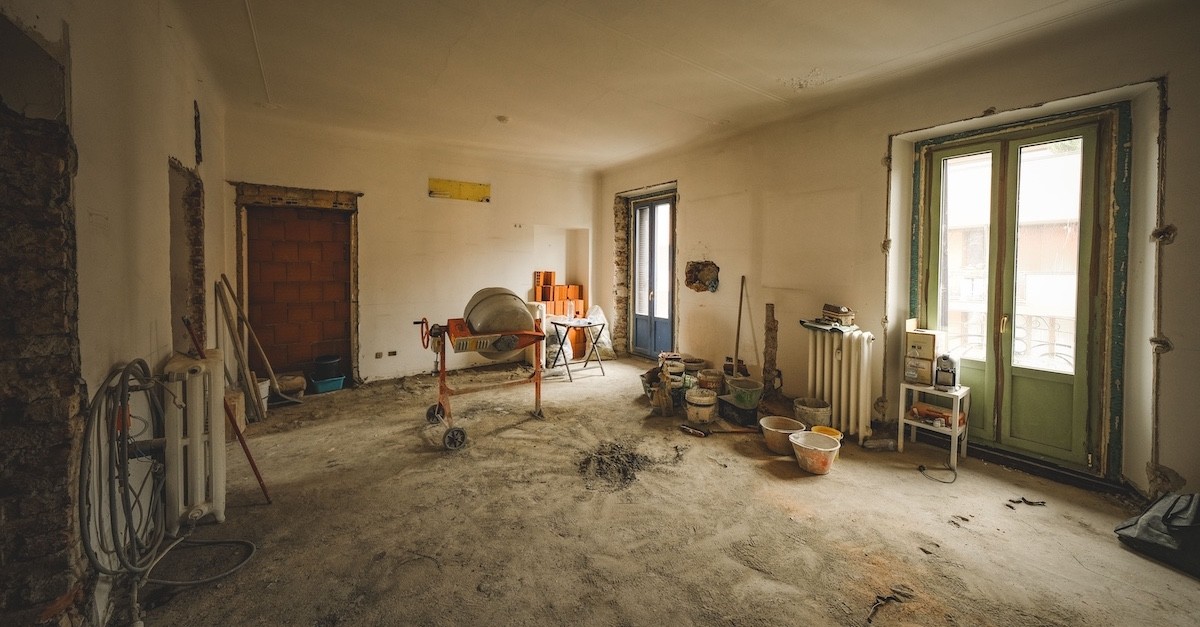
Which works are deductible in 2026?
For operational details and the requirements for accessing renovation tax deductions in 2026, the institutional reference remains the Italian Revenue Agency’s 2026 Building Renovation Guide. Eligible works are divided into four main practical categories.
Work on individual homes
Inside private homes, only work that goes beyond ordinary maintenance is eligible:
- Internal renovation: fully renovating a bathroom, including systems, sanitary fittings and tiles; moving internal partition walls to redistribute rooms; splitting one flat into two units; or combining two adjoining properties.
- Security and prevention systems: installing security doors, window grilles, security shutters, shatterproof glass, wall safes, alarm systems, video-surveillance systems, and gas-leak or fire detectors.
Work on shared areas in apartment buildings
In condominium buildings, the scope of the deduction is broader. Alongside the extraordinary work that is valid for individual homes, ordinary maintenance on shared areas is also eligible under Article 1117 of the Italian Civil Code:
- Painting façades, entrance halls and stairwells.
- Repairing and replacing external flooring, flat roofs, pitched roofs and gutters.
- Replacing entrance doors, window frames and fittings in communal areas.
Sustainability, accessibility and ancillary structures
This category includes removing architectural barriers, such as installing stairlifts and lifting platforms, or building compliant ramps. Following the end of the special 75% rate, these works fall under the standard 50% or 36% rates.
Work linked to renewable energy and ancillary structures can also qualify. This includes installing photovoltaic systems with storage batteries, building or buying garages and parking spaces classed as ancillary to a home, limited to construction costs certified by the developer, and seismic reinforcement work.
Eligible additional costs
The deduction applies not only to materials and labour, but to the full financial scope of the project:
- Technical costs: fees for architects, surveyors and engineers for design work, site supervision, testing and preparing the APE energy performance certificate.
- Administrative costs: expenses for obtaining the required permits, such as a CILA, SCIA or Permesso di Costruire, along with administrative fees and stamp duty.
- Taxes: VAT charged on invoices for goods and services connected with the work.
What are the changes to the 2026 renovation bonus?
The 2026 Budget Law (Law No. 199/2025) introduced substantial changes to the rules for building incentives, setting stricter conditions for rates and eligibility:
- Confirmation of the two-tier system: the 50% deduction is retained for spending on a main residence, while the rate for second homes is definitively reduced to 36%. The maximum spending limit remains €96,000 per property.
- Introduction of an income limit: an income threshold has been introduced for tax deductions relating to renovation work in 2026 for higher-income taxpayers, with income above €75,000 and €100,000. The total amount of deductible expenditure is reduced according to the household coefficient.
- Alignment of the Ecobonus and Sismabonus: the previous higher rates, including 65%, have been removed. Energy-saving and seismic-reinforcement work is now aligned with the general system, at 50% for a main home and 36% for second homes.
- End of previous incentives: the Superbonus ends nationwide, apart from exemptions for municipalities in earthquake-affected areas, while the special 75% deduction for removing architectural barriers has also been withdrawn.
- Reorganisation under the new TUIR: Legislative Decree No. 117/2026 reorganised building incentives within the Consolidated Income Tax Act (Testo Unico delle Imposte sui Redditi, or TUIR), under Articles 17, 371, 372 and 373. It provides a single, coherent legal framework in force from 1 January 2027.
Tax-credit transfers and invoice discounts in 2026
One of the most common concerns among taxpayers is the possibility of receiving the incentive straight away rather than recovering it over time. The position is clear: in 2026, invoice discounts (sconto in fattura) and tax-credit transfers (cessione del credito) are no longer available for new building-renovation projects.
Following the gradual legal restrictions introduced to contain public spending, these options have been permanently removed for almost all construction projects. The only remaining way to benefit from the 2026 renovation bonus is through the direct IRPEF deduction on the tax return, using either the Modello 730 or the Modello Redditi Persone Fisiche.