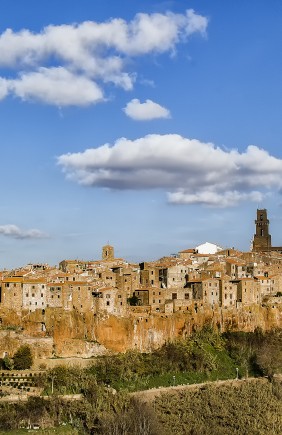
When the southern sun hits walls whitewashed with lime, entire villages seem suspended between sky and earth. Italy’s white towns were not created for tourism, but are the result of practical, hygienic and even defensive choices developed over centuries.
They are found mainly in the South, where white helped reflect the heat and brighten narrow, dark alleyways.
Why do white towns exist in Italy?
The white colour of the houses has very practical origins, tied to everyday life in the past.
Lime was an inexpensive and readily available material, useful for bringing light into the narrow streets of medieval historic centres. The reasons this tradition became widespread can be summed up as follows:
- Hygiene: lime was believed to have disinfectant properties, and during epidemics and outbreaks of plague, whitewashing façades was seen as a protective measure.
- Practicality: it was a low-cost material, easy to apply and helpful in brightening interiors.
- Defence: according to some accounts, white walls reflected sunlight, dazzling enemies and giving residents time to take shelter.
In some municipalities, the use of lime was even regulated by law, showing how deeply rooted the practice was.
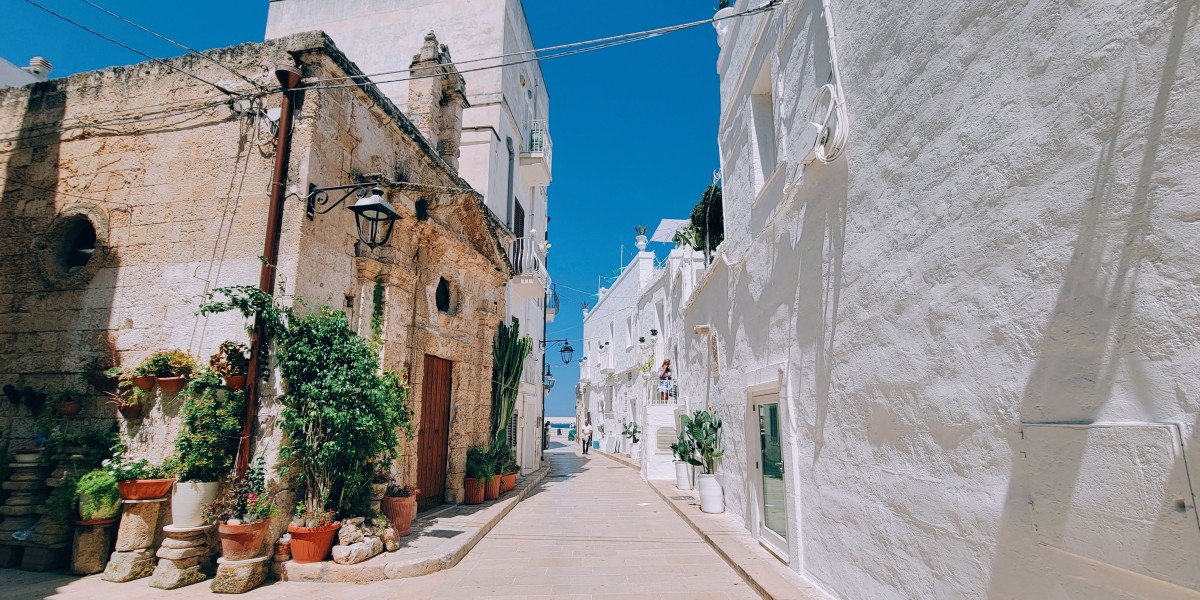
Ostuni, the “White City” par excellence
When talking about white towns in Italy, the mind immediately goes to Ostuni, in the province of Brindisi. Its historic centre is a maze of whitewashed houses, arches and stairways climbing a hill that overlooks the Adriatic. The tradition of white dates back to the Middle Ages, when a severe outbreak of plague struck the area, and survivors turned to lime to sanitise their homes.
To preserve this uniform colour scheme, the municipality of this Puglian white town issued an ordinance requiring residents in the centre to paint their houses white. With around 31,000 inhabitants, Ostuni today combines the appeal of a historic village with a coastline that has repeatedly been awarded the Blue Flag.

The Itria Valley: three white villages just minutes apart
Anyone looking for a concentration of white towns will find the Itria Valley an ideal destination. Among dry-stone walls, centuries-old olive trees and trulli, there are three villages belonging to different provinces but only a few minutes’ drive from one another.
Locorotondo, the circular village
Locorotondo, in the province of Bari, owes its name to the circular layout of its historic centre, made up of concentric streets and low limewashed houses. It stands on a hill overlooking the Itria Valley, with wide views across the rural landscape.
Its distinctive houses with sloping roofs give it a unique architectural character. The village is listed among the Most Beautiful Villages in Italy and has been awarded the Orange Flag by the Italian Touring Club.

Cisternino, the kingdom of the grill
Cisternino is widely loved by fans of good food. Its gastronomic institution is the braceria: you choose fresh meat at the butcher’s counter and eat it grilled on the spot. The historic centre is a network of white alleyways, courtyards and small squares.
Cisternino has also received the Orange Flag award, given by the Touring Club to small inland towns with fewer than 15,000 inhabitants that provide a high-quality visitor experience. It is an ideal destination for those who like to combine a stroll with good food.

Martina Franca, the baroque soul
Martina Franca, in the province of Taranto, stands out for the contrast between its widespread white façades and the richness of its baroque architecture. Its bright alleyways suddenly open onto theatrical squares, with wrought-iron balconies and decorated doorways. The historic centre reflects a noble past, visible in its grand palaces and churches.
The town is also known for its summer music festival, which brings opera into the streets of the old quarter. It represents the more aristocratic face of Puglia’s white towns.
- Property for sale in Martina Franca
- Long-term rentals in Martina Franca
- Holiday homes in Martina Franca

Beyond Puglia: the white town of Sperlonga
Although Puglia is the undisputed queen of white towns, the phenomenon does not end in Salento or the Itria Valley. Along the coast of Lazio lies Sperlonga, a Mediterranean white village perched on a rocky spur above the sea.
Its whitewashed houses, arches and stairways descending towards the beach evoke the atmosphere of the Greek islands. Sperlonga is also listed among the Most Beautiful Villages in Italy.

Stay inspired for your travels in Italy —get our weekly newsletter for the latest travel, legal, and lifestyle news.