Halloween may bring Ireland and Scottish castles to mind, but Italy has plenty of spooky places where the atmosphere changes once darkness falls. Across the Alps, Apennines and southern regions, there are fortresses, ruins and abandoned villages where documented history has given rise to popular tales that have lasted for centuries.
The important distinction is simple: apparitions belong to folklore, while the stone buildings are real and open to visitors. That is where the appeal lies: frescoed courtyards, crenellated walkways and squares without residents leave plenty of room for the imagination.
Castles and legends: Montebello and Bardi
Two fortresses in northern Italy reveal different sides of the Middle Ages. One is linked to the story of a disappearance that repeatedly returns in collective memory; the other has a tale of weapons and love that has survived the centuries.
Montebello Castle: Azzurrina, myth and the Middle Ages
In the hills near Rimini, in Montebello di Poggio Torriana, stands a fortress that has become closely associated with mystery. The legend of Azzurrina, a child said to have disappeared in the 14th century, has long accompanied guided tours and adds an air of suspense.
Beyond the popular story and alleged recordings of unexplained phenomena, the site remains an effective fortified complex, with towers and rooms that speak of territorial control.
Bardi Castle: Moroello and Soleste, weapons and romance
In the Parma Apennines, Bardi Castle rises on a rocky spur, with a distinctly military purpose. Its best-known tale concerns Moroello and Soleste, a tragic love story passed down in several versions, adding a romantic thread to the stern outline of the walls.
Here too, ghostly presences belong to local legend. The halls, walkways and commanding position above the Ceno Valley, meanwhile, clearly reveal the complex’s historical function.
The classic fortress: Fénis in the Aosta Valley
If there were a textbook image of a medieval fortress, Fénis would fit it closely. Crenellated walls, towers, frescoed courtyards and covered walkways shape a manor that does not need ghosts to leave an impression.
Its history is well documented and tied to the Challant family, a major presence in the Aosta Valley. Stories of apparitions remain in the realm of oral tradition, while the architecture gives a tangible sense of courtly life, shaped by display and defence.
Real ghost villages: Craco and Roscigno Vecchia
Southern Italy holds two places where the unease comes not from spirits, but from the emptiness left behind by residents. The streets pass empty houses, open façades and lanes where time seems to have stopped.
Craco, Basilicata: a village left hanging in time
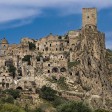
Silent houses, a Norman tower above the calanchi — the region’s eroded clay gullies — and a recognisable street plan without everyday life: Craco is a snapshot of a village left hanging in time.
Repeated landslides and the 1980 earthquake led to its abandonment, preserving its layout while erasing its day-to-day life. Visits must follow established routes and arrangements to minimise risks.
Roscigno Vecchia, inland Cilento: memory set in stone
In the heart of the Cilento area, Roscigno Vecchia tells the story of a necessary relocation, carried out for hydrogeological reasons.
The houses remain, but the residents do not. It is the physical trace of a collective farewell that unfolded over years. Access here also requires care and respect for local guidance and rules.