Just outside Parma, tucked into the Emilian countryside, there’s a place that quietly claims a world record. The world’s largest bamboo labyrinth is far more than a novelty maze. It’s a cultural park built around art, architecture and a slightly obsessive love of bamboo.
The bamboo labyrinth: scale, structure and design
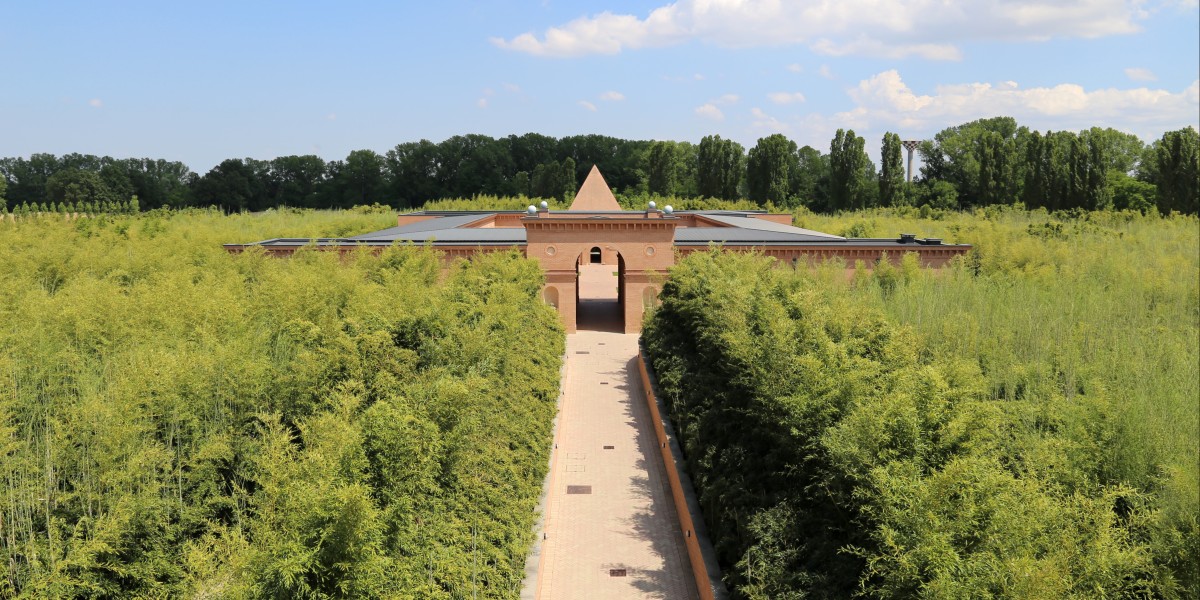
The Labirinto della Masone is described as the largest bamboo maze in existence. Around 300,000 bamboo plants form its winding corridors, with heights varying between 3 and 15 metres. Approximately 20 species are represented across the site, including both dwarf and giant varieties.
The layout follows the shape of an eight-pointed star, referencing historic star-shaped fortified cities. Because the geometry isn’t obvious at ground level, a scale model installed on site allows visitors to see the full design in miniature.
Bamboo is used beyond the maze itself. Inside the complex, even the parquet flooring has been made from the same material, reinforcing the idea that the plant is central to the entire concept.
In the middle of the maze sits a square enclosed by arcades and large halls. Overlooking it is a pyramid-shaped chapel, which recalls the labyrinth as a symbol of faith. It adds a spiritual layer to what is otherwise an architectural and artistic project.
Franco Maria Ricci’s vision
The labyrinth was conceived and developed by Franco Maria Ricci, a publisher and collector with a deep interest in books, art and bamboo as a material. The entire project grew out of his personal fascination with the plant and its architectural possibilities.
Neoclassical architecture and Pier Carlo Bontempi
The buildings within the complex were designed by Pier Carlo Bontempi, a Parma-born architect who works internationally. His approach draws heavily on classical forms and traditional Italian and European architectural tenets.
The structures are inspired by the neoclassical architectural utopias associated with the era of the French Revolution, which imagined bold, visionary projects.
Art collection, library and cultural spaces
Within the complex, a dedicated building houses Ricci’s private collection of art. The holdings include around 500 works, dating from the 16th to the 20th century, spanning Renaissance sculpture through to 20th-century pieces.
Stay inspired for your travels in Italy —get our weekly newsletter for the latest travel, legal, and lifestyle news.