A 173% jump in visitors compared with last year is redrawing the map of tourism in the Veneto. Vicenza, a UNESCO World Heritage Site since 1994, has gone from hidden gem to must-visit destination.
Art here isn’t locked away in museums. It’s in the squares, the loggias and the villas designed by Andrea Palladio. The historic centre is cohesive and theatrical, it charms you straight away, and it’s easy to plan around. Here’s why it’s drawing visitors who might once have headed straight to nearby Venice, and how to make the most of a weekend.
Why Vicenza is suddenly booming
The headline figure is hard to ignore: visitor numbers are up 173% year on year, building on an already positive trend. Vicenza is also gaining ground in travellers’ choices compared with Venice.
Part of the appeal is how easy the centre is to explore. Renaissance architecture sits alongside Gothic palaces and Baroque touches, and it all feels effortlessly harmonious. Its UNESCO listing, awarded in 1994, well ahead of many other Italian destinations, is now a powerful signal of quality.
The Palladian masterpieces that make Vicenza unique
Born in Padua in 1508, Palladio turned Vicenza into a laboratory of harmony and proportion. His restrained, balanced style shaped Western architecture for centuries and is often cited as an influence on landmarks as far away as the White House.
In Vicenza, his work isn’t a handful of isolated showpieces but a coherent whole, from grand urban backdrops to villas designed for contemplation and study. These are the three places to start.
Basilica Palladiana
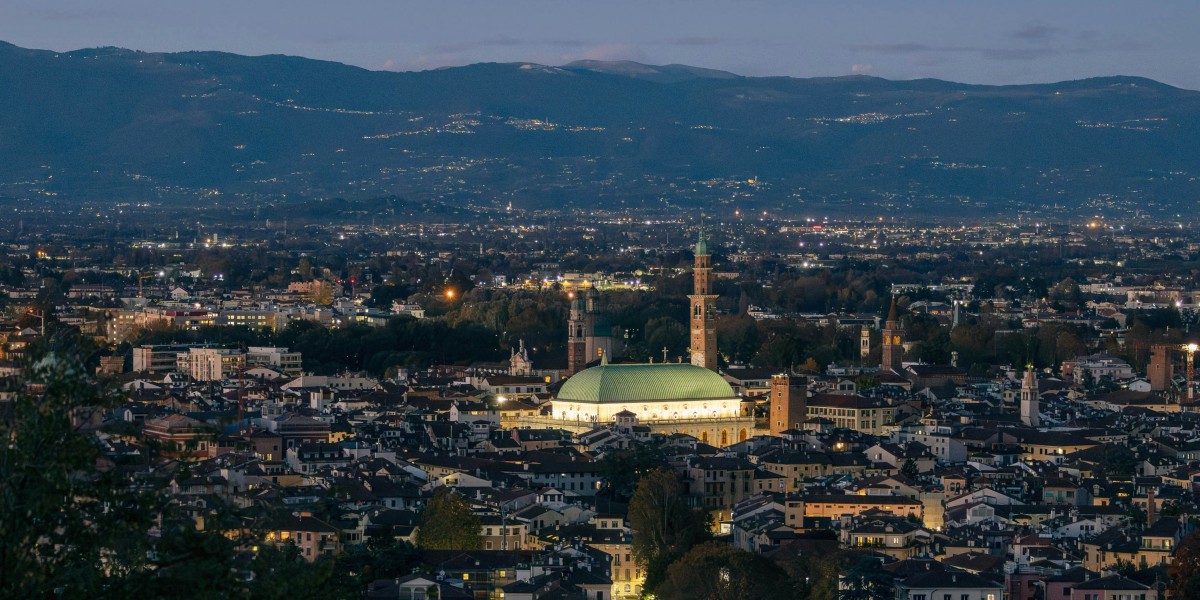
The symbol of Vicenza’s identity stands in Piazza dei Signori. Despite its name, the Basilica Palladiana isn’t a church. It’s a flexible civic building that now hosts exhibitions and events.
Its pale stone loggia, lined with arches of rigorous proportions, supports a vast copper roof shaped like an upturned ship’s hull. The upper terrace is one of the best spots to look out over the city and the surrounding hills.
Teatro Olimpico
The Teatro Olimpico is considered the first permanent indoor theatre of the modern era, a turning point in the history of European stagecraft. Palladio drew on the layout of Roman theatres and reworked it with Renaissance ingenuity, but he died soon after construction began.
A pupil completed it in 1585, and it opened with Sophocles’ Oedipus Rex, a sign of how ambitious the project was. It still hosts plays, concerts and festivals today, especially during the classical music and opera season.
Villa La Rotonda
Just outside the centre, Villa Almerico Capra, known as La Rotonda, is a lesson in symmetry built in stone. Commissioned by the priest Paolo Almerico in 1566, it was designed as a place of rest and reflection rather than a working farm residence, anticipating a new, more cultured way of living in the countryside.
A square plan with a domed circular hall at its heart gives rise to four identical façades, each with a monumental portico of Ionic columns. The result is a perfectly balanced building in constant dialogue with the landscape.
Beyond Palladio: a historic centre full of surprises
Vicenza is far more than its most famous architect. The heart of the city is a mix of lanes, small squares and buildings from many eras. Corso Palladio is its commercial and social backbone, lined with shops, cafés and historic residences.
Piazza dei Signori, Torre Bissara and Palazzo Chiericati
The city’s main square, overlooked by the Basilica, is Vicenza’s open-air stage. Here rises the Torre Bissara, an 82-metre tower that defines the skyline and keeps up a local tradition: a melody known as the “ora nona,” played six minutes before midday and again six minutes before 6pm.
A short walk away, Palazzo Chiericati houses the Museo Civico, with a collection spanning the Renaissance and the 18th century, in a setting that blends seamlessly into the city around it.
How to get to Vicenza and get around
Vicenza sits between Venice and Verona, a strategic base for exploring north-east Italy.
- By car: Take the A4 Turin–Trieste motorway. Use the Vicenza Est junction if you’re coming from the Turin side, or Vicenza Ovest from the Trieste side, whichever suits your route best.
- By train: Regional trains and high-speed Frecciarossa services run frequently along the Milan–Verona–Venice line, a handy way to avoid city traffic. The station is near Campo Marzo, right next to the historic centre, so it’s easy to explore on foot and make short stops.
Several other destinations are within easy reach, including Bassano del Grappa (about 35 km), Padua (about 36 km) and Treviso (about 60 km), which makes it simple to stretch your trip into a multi-stop itinerary.
Thinking of Living in Vicenza?
If the boom has you wondering what it would be like to stay longer, the property market makes a good case. According to idealista’s price reports, homes for sale in the province of Vicenza averaged €1,476 per m² in May 2026, compared with €2,409 in Verona and €2,748 in Venice. In the cities themselves the gap is wider: Vicenza was at €1,748 per m² in March 2026, while Venice reached €4,956 per m² and Verona €2,955 in September.
The location does a lot of the work. With fast trains to Venice, Verona and Milan, you can live in a calm, walkable Palladian city and still reach the lagoon or Lake Garda easily. Beyond the centre, the hills and the villa-dotted countryside offer more space and quieter surroundings, which suits remote workers, families and anyone planning a longer stay in Italy.
One thing to bear in mind: resale demand in Vicenza is thinner than in Venice, Verona or Padua, so it’s worth working with a local agent and thinking about your plans for the property before you buy.