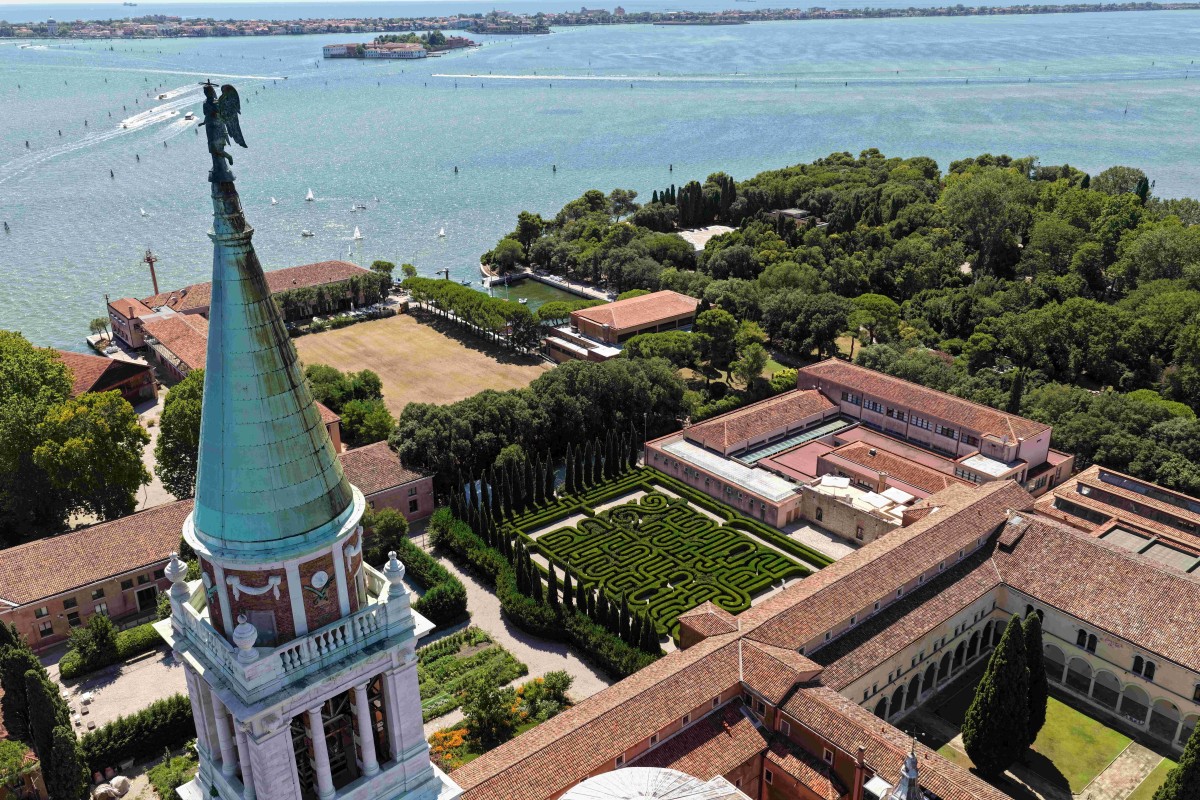
Forty years after the death of Jorge Luis Borges and 15 years after its inauguration, the labyrinth dedicated to him by the Giorgio Cini Foundation on Venice’s Island of San Giorgio Maggiore has been renewed.
One of the Venetian cultural heritage’s most iconic and poetic spaces has now reopened to the public.
An idea born from friendship and a dream
The story of the Borges Labyrinth begins with a friendship.
The garden was conceived by the English architect and diplomat Randoll Coate (1909–2005), a close friend of the Argentinian writer. He was introduced to Borges in 1950 by writer Susan Bombal. The project developed between 1979 and 1986, after Coate had a dream that foretold his friend’s death.
Borges, for his part, had always loved Venice, seeing it as a city-labyrinth. In 1984, two years before his death, he returned to the Island of San Giorgio Maggiore to chair the international colloquium Europe and Culture, promoted by the Municipality of Venice and the Commission of the European Communities.
The labyrinth draws inspiration from Borges’s 1941 story The Garden of Forking Paths, a visionary detective story in which several parallel realities coexist. It pays tribute to quantum theories and contemplates, in the author’s own words, “an infinite series of times, in a growing, dizzying net of divergent, convergent and parallel times”.
The labyrinth is also a recurring symbol throughout Borges’s work: an archetype for the nature of the universe and human uncertainty in the face of existence, a projection of fears and an image of hope. Every labyrinth has its own logic, allowing people to enter, get lost and eventually find the way out.
The project: an open book formed by boxwood hedges
In Coate’s design, the labyrinth takes the form of an open book. The hedges are arranged to spell “Borges” in mirror image across two pages, scattered with symbols from the writer’s work: a walking stick, mirrors, an hourglass, sand, a tiger and a question mark.
A first version was created in 2003 by the Fundación Internacional Jorge Luis Borges, led by Borges’s widow, María Kodama, at “Los Alamos” near San Rafael, Argentina.
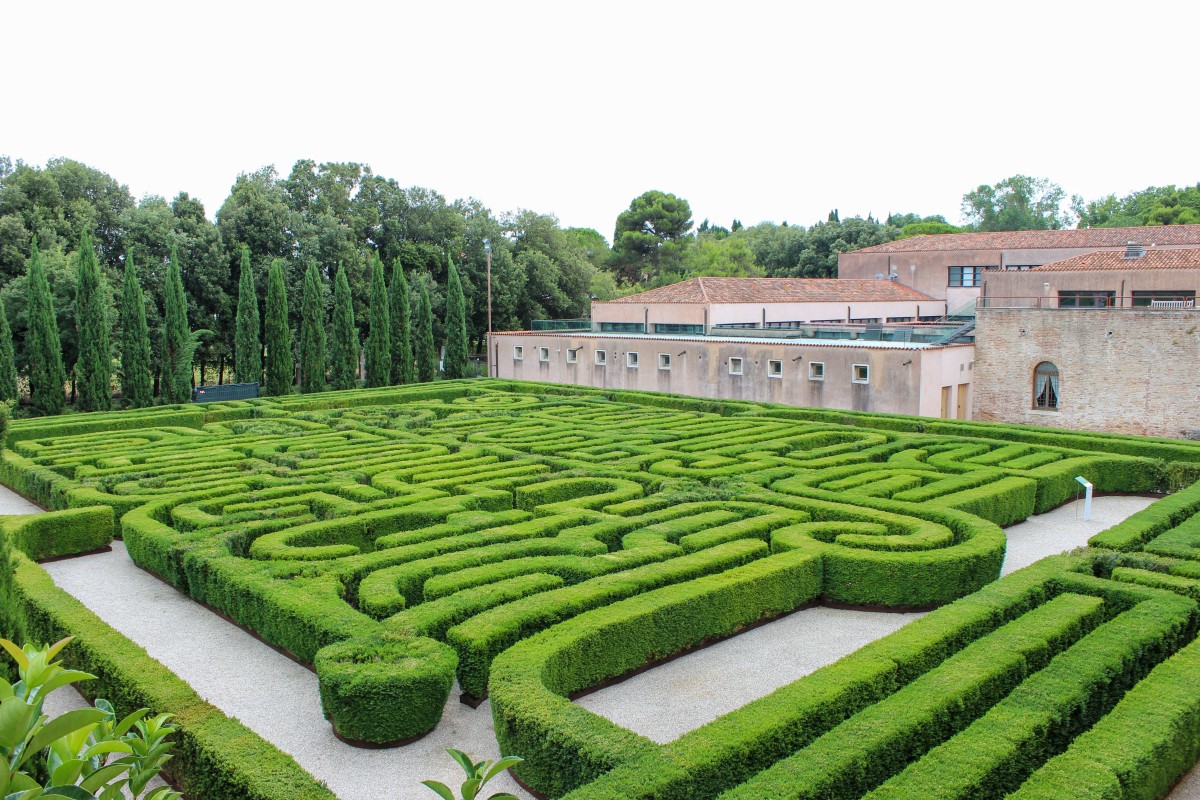
The Venetian version, inaugurated in 2011 to mark the 25th anniversary of the writer’s death, covers an area of 2,300 square metres on the Island of San Giorgio. It consists of 3,250 boxwood plants, up to around 38–40 centimetres wide and 75 centimetres tall above ground level, placed 75 centimetres apart. Its internal paths extend for 1,150 metres.
Rows of cypress trees line the north-west and eastern sides, evoking a green colonnade. Open to the public in 2021 through VisitCini guided tours, it welcomed more than 25,000 visitors in its first five years, becoming almost a third cloister within the monumental complex, after the Buora and Palladio cloisters.

The restoration: 165 plants removed, fresh soil and irrigation restored
Fifteen years outdoors had taken their toll. The restoration began with the removal of 165 dead or compromised boxwood plants and a full inspection of the irrigation system, including the replacement of non-functioning lines.
Around two cubic metres of new, suitable soil were added to support the proper establishment of the new planting. The replacement boxwood plants were selected with already well-developed foliage and pruned to match the existing shape of the labyrinth.
Accessibility: step-free routes and a tactile map for blind visitors
The restoration included two important accessibility measures.
The first concerns the entrance path: excess gravel was removed, the routes were marked out and levelled, and honeycomb panels certified for use by people with mobility impairments were installed.
This has made the route natural, pleasant and safe.
The second measure was carried out in partnership with the Venice branch of the Italian Union of Blind and Partially Sighted People.
A tactile map has been installed to reproduce and explain the labyrinth, giving blind and partially sighted visitors information about the route before entering the boxwood hedges.

When to visit Venice’s Borges Labyrinth
The labyrinth has been open to visitors since mid-July 2026, with updated opening times available on the visitcini.com website.
In autumn, PwC Italy will provide a weekend of free public access, with booking arrangements to be announced through the official channels of the Giorgio Cini Foundation and PwC Italy.