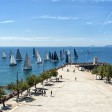
Tucked away on the Tuscan coast is a square that seems to hang above the waves, often described as the largest clifftop sea terrace in Europe. This is Piazza Bovio, the icon of Piombino. Within a few steps, your gaze crosses the Piombino Channel and takes in the Tuscan Archipelago, with views that on clear days stretch all the way to Corsica.
The square was created in the early twentieth century, after the old Rocchetta fortress was demolished and its buttresses were put to new use.
Where is Piazza Bovio, and what makes it special?
Piazza Bovio sits at the tip of the Piombino promontory in the province of Livorno, within the Val di Cornia, an area covering the southern parts of the provinces of Livorno and Pisa. Piombino is a town of just over 30,000 people, best known for its strategic port, and this square is its true urban emblem.
What sets it apart is not only its position at the water’s edge but also its outlook, frequently cited as the widest sea-facing terrace in Europe. The result is an open-air public living room: a scenic platform that engages with the sea directly and constantly.
A view that takes in the whole archipelago
The real draw of Piazza Bovio is its panorama. Your eye travels across the Piombino Channel and then opens out towards the Tuscan Archipelago, a view that shifts with the light and the seasons.
You can pick out the peaks of Elba and, closer in, the islets of Cerboli and Palmaiola, which dot the sea like quiet landmarks. When the air is crisp, the horizon stretches even further, revealing Corsica and Giannutri.
Landmarks of the terrace: the Compass Rose and the Rocchetta Lighthouse
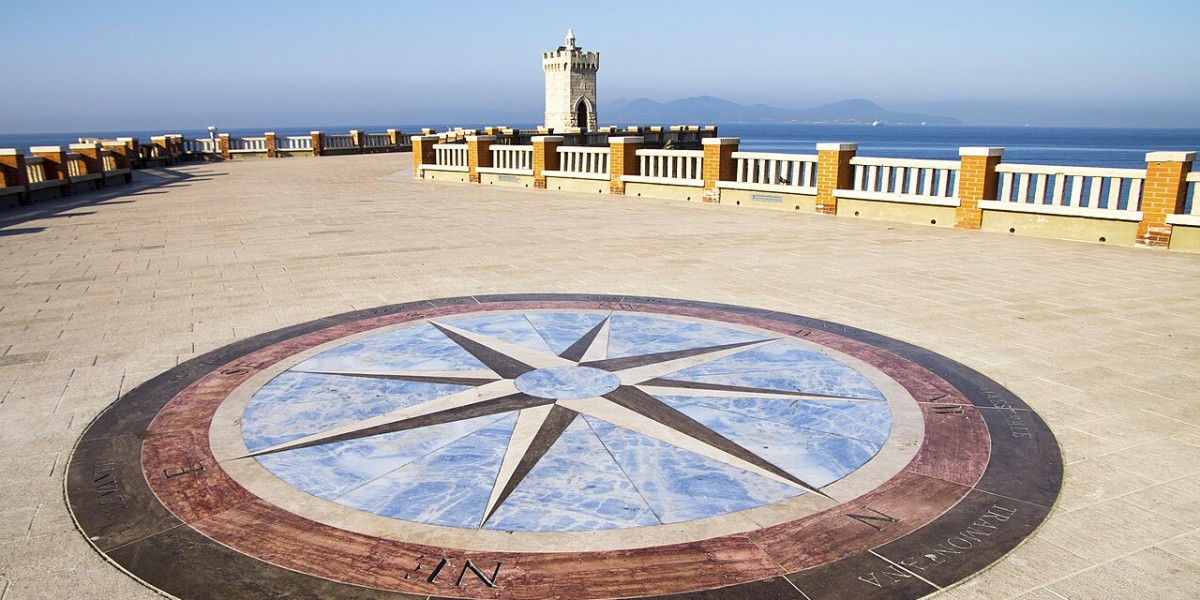
Underfoot, a compass rose greets visitors, set discreetly into the overall design. The Rocchetta lighthouse, built in a neo-medieval style, completes the scene and remains one of Piombino’s most distinctive symbols.
From fortress to seafront square
The story of Piazza Bovio began with a bold urban decision: in the early twentieth century, the old Rocchetta was demolished and its buttresses reused to create a grand public viewpoint.
The result is a clean, geometric clifftop terrace that makes the most of the promontory’s dramatic position. It still works beautifully today, combining function and landscape in a single gesture.
What to see in Piombino beyond Piazza Bovio
The terrace is the town’s calling card, but Piombino holds many other treasures. Within just a few blocks you’ll find religious and civic buildings that reveal deep layers of history.
- Co-Cathedral of Sant’Antimo: built in the thirteenth century as a place of worship dedicated to St Michael.
- Church of the Misericordia: among the town’s oldest monuments, dating from the first half of the thirteenth century.
- Cittadella Chapel: dated 1465, a testament to the late medieval period.
- Town Hall (Palazzo Comunale): erected in 1444, marking the historic administrative heart of the town.
- Casa delle Bifore: built in the late thirteenth century and recognisable by its Gothic design.
- Il Torrione: the main land gateway into the town, dating from 1212.
- Il Rivellino: a defensive structure raised in 1447, forming part of the town’s fortifications.
Etruscan roots and great masters
Piombino and its surroundings have much to offer beyond the medieval era. The town’s Etruscan origins, visible in several local works, form an early cultural foundation that still shines through today.
In the centuries that followed, the town developed its own architectural identity, shaped by figures such as Leonardo da Vinci and Andrea Guardi, evidence of a deliberate and thoughtful approach to design.