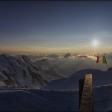
At more than 4,500 metres above sea level, where thin air makes every breath harder and the night sky puts on an unequalled display, stands a building unlike any other in Europe.
A wooden cabin, perched on Punta Gnifetti in the Monte Rosa massif, has held the continental record as Europe’s highest mountain refuge for more than 130 years. Its story intertwines mountaineering, scientific research and national pride. This is not simply a place to sleep, but a human outpost at the edge of what can be inhabited.
- Where Europe’s highest mountain refuge is located
- The history of Capanna Regina Margherita
- What Capanna Regina Margherita has today: facilities
- How to reach Europe’s highest mountain refuge
- Prices, booking and practical information for staying overnight
- Capanna Regina Margherita and the Milan Cortina 2026 Olympics
Where Europe’s highest mountain refuge is located
Capanna Regina Margherita stands on Punta Gnifetti, one of the main peaks in the Monte Rosa massif, on the border between Italy and Switzerland. Administratively, the refuge is in Italian territory, in the province of Vercelli, Piedmont.
At 4,554 metres above sea level, it is officially recognised by the Italian Alpine Club as Europe’s highest mountain refuge. This distinction makes it a striking destination for anyone drawn to the Alps’ most extreme environments.
Punta Gnifetti is slightly lower than Monte Rosa’s highest summit, Punta Dufour, at 4,634 metres, but its permanent refuge is what has made it internationally recognised.

The history of Capanna Regina Margherita
It all began in July 1889, when the assembly of delegates of the Italian Alpine Club approved plans to build a permanent shelter above 4,500 metres. The aim was twofold: to provide a safe base for mountaineers exploring Monte Rosa and, above all, to establish a permanent base for scientific research.
Construction was a major logistical undertaking. The necessary materials were transported first by mule as far as possible, then carried on workers’ backs to the summit of Punta Gnifetti, across glaciers and through high winds and extreme temperatures.
The refuge was inaugurated in the summer of 1893, at an event made memorable by the exceptional presence of Queen Margherita of Savoy. She reached the summit and spent the night there in August of the same year. The refuge was named Capanna Regina Margherita in her honour.
The 1980 reconstruction
The original 19th-century building did not withstand the extreme conditions at high altitude. Worn down by decades of snow, ice and fierce winds, it was demolished in 1979 and replaced with an entirely new structure, inaugurated on 30 August 1980.
The new building was designed with its environmental impact on a fragile ecosystem in mind. In 2002, it received UNI EN ISO 14001 environmental certification, confirming the refuge’s ecological management system.
What Capanna Regina Margherita has today: facilities
The current Capanna is not a basic emergency bivouac. It is an equipped mountain refuge combining sporting, scientific and hospitality functions. It has 70 beds – reduced to 10 during winter – in rooms with bunk beds, a restaurant room, shared toilets, electric lighting and Wi-Fi access.
One of its most intriguing details is a small library, set up by the Italian Alpine Club in 2004 with donations from publishers. With shelves at 4,554 metres above sea level, it is considered Europe’s highest library.
The ARPA Piemonte weather station
On the roof of the Capanna is a weather station belonging to ARPA Piemonte’s monitoring network, which has collected continuous data since 2002. Its readings are transmitted in real time, contributing to regional weather forecasts and research into the Alpine climate.

How to reach Europe’s highest mountain refuge
Reaching Capanna Regina Margherita is not a trip for everyone. It is a glacier mountaineering ascent, requiring technical equipment and glacier experience.
Anyone without that background needs to be accompanied by a certified mountain guide. Going independently without solid mountaineering preparation is not advisable.
Routes on the Italian side
On the Italian side, the most frequently used routes begin at Rifugio Gnifetti (2,867 m) and climb the Lys Glacier, passing Capanna Gnifetti (3,647 m) before reaching Punta Gnifetti.
The most common starting point is Alagna Valsesia, linked to higher elevations by a lift reaching Passo dei Salati. Ascent times vary according to glacier conditions, the season and the rope team’s fitness and experience.
Access from the Swiss side
On the Swiss side, access typically starts at the Monte Rosa Hütte (2,883 m), reached from Zermatt, and continues across the Grenz Glacier. The route is popular with climbers coming from Switzerland and has different but equally impressive Alpine scenery.
How much it costs to reach the refuge
A mountain guide, travel, possible use of lift systems and an overnight stay bring the overall cost to several hundred euros per person.
Prices, booking and practical information for staying overnight
The Capanna operates fully during the summer months, generally between June and September, although this depends on mountain conditions. Anyone planning to stay overnight at Capanna Regina Margherita needs to arrange things well in advance.
The refuge is run by the Italian Alpine Club (CAI) and has 70 summer beds, divided between bunk-bed rooms. The service includes sleeping duvets, meals at the refuge and use of shared facilities.
Booking arrangements, current rates and bed availability change each season, and can vary according to weather conditions and the state of the mountain.
Capanna Regina Margherita and the Milan Cortina 2026 Olympics
In January 2026, Capanna Regina Margherita played a leading role in the story of the Milan Cortina 2026 Winter Olympics.
The Olympic torch reached Europe’s highest mountain refuge on 13 January 2026, carried there by mountain guides from Gressoney, Champoluc, Alagna, Macugnaga and Zermatt.
It was a symbolic moment celebrating Italian mountaineering before the flame descended to Passo dei Salati and then to the village of Gressoney-La-Trinité.
Stay inspired for your adventures in Italy —get our weekly newsletter for the latest travel, legal, and lifestyle news.