Castles have always carried an air of mystery, guarding fascinating stories: hidden secrets, traces of distant eras, and tales of nobles, ladies and knights.
Across Italy, from north to south, there are castles, fortresses and strongholds that attract thousands of visitors each year, all keen to uncover their history and soak up the atmosphere as they wander through grand halls and silent courtyards.
Here is a selection of five Italian castles, some famous, others less well known, but all with a remarkable past.
Ferrara and the Este Castle
The year is 1385. The people of Ferrara, worn down by famine, rise against their rulers in a violent revolt. The uprising is so significant that Nicolò II d’Este, lord of the city, orders the construction of the Great Castle of San Michele, today a symbol of the power of the Este family and of Ferrara itself.
Ferrara has been declared a UNESCO World Heritage Site, and when visiting the castle you can be accompanied by two exceptional guides: Lucrezia Borgia and Ludovico Ariosto. Not in person, of course, but through theatrical tours led by professional actors in period costume.
You can discover the key figures who shaped the castle’s history, along with its secrets, court intrigues and enduring legends.
Rome: Castel Sant’Angelo and its secrets

Castel Sant’Angelo was built in AD 123 at the request of Emperor Hadrian and is also known as Hadrian’s Mausoleum.
Its story is closely tied to that of the city of Rome. Originally conceived as a tomb, it later became a coveted stronghold for powerful Roman families seeking control of Rome, until Pope Boniface V received its keys. From that moment on, its fate was bound to the popes, who often used it as a refuge in times of danger.
Through the initiative known as “The Secret Castle”, visitors can explore some of the most mysterious parts of Castel Sant’Angelo. Step into the prisons, the Passetto (the elevated passageway linking the castle to the Vatican) and the ornate bathroom of Clement VII.
As you move from room to room, nearly 2,000 years of history unfold in one of the few Roman-era buildings to have survived intact to the present day.
Verona and Castelvecchio

In the city of Romeo and Juliet, an essential stop is the most important military monument of the Scaliger rule: Castelvecchio. It was built in the 14th century by the Della Scala family, who wanted a fortress where they could protect themselves from popular uprisings and enemy sieges.
It is exactly what you picture when you think of a medieval castle: towers, thick walls, a moat fed by the River Adige, drawbridges and a majestic fortified bridge protected by a keep. Over the centuries, this imposing structure has witnessed many of the events that shaped the history of Verona and Italy.
Today, the castle houses the Castelvecchio Museum, restored in the 1950s. Inside, you’ll find works by Pisanello, Veronese, Tintoretto, Mantegna and other great artists, all within walls that still retain a distinctly medieval atmosphere.
Spoleto and the Rocca Albornoziana

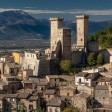
Less well known but no less fascinating, the majestic Rocca Albornoziana stands on a hill in the beautiful city of Spoleto. Between 1363 and 1367, Pope Innocent VI commissioned the construction of this imposing fortress, entrusting the task to the Spanish cardinal Egidio Albornoz, from whom it takes its name.
These were the years when the papal seat was being re-established in Rome, after more than 70 years in Avignon. The pope therefore ordered the construction of a building that would serve both as a solid fortress and an elegant residence, capable of hosting distinguished guests.
Until the 16th century, the Rocca played a central role, welcoming popes, governors, lords and even Lucrezia Borgia, who stayed there on several occasions. Later, between 1817 and 1892, following a period of decline, the fortress was converted into a prison.
One of the best ways to appreciate the site is by following the “Giro della Rocca”, a walk of about one kilometre that circles the park and fortress, allowing you to take in the panorama.
Caccamo and its legends

Caccamo is a medieval town in the province of Palermo, home to one of the largest and best-preserved fortresses in Sicily. Perched on a rocky outcrop overlooking the landscape, it dominates the surrounding countryside.
To reach it, you climb a stone staircase, and it is easy to feel transported back to the Middle Ages, imagining the many knights who once walked the same path. Originally built as a defensive fortress, the castle was later transformed into an opulent residence for Sicilian nobles and ruling families.
According to tradition, visitors may even encounter the ghost of Matteo Bonello, one of the castle’s earliest owners. Legend has it that his spirit still wanders through the halls of his former home, where he was brutally murdered by one of his enemies, known as William the Bad.
Stay inspired for your travels in Italy —get our weekly newsletter for the latest travel, legal, and lifestyle news.