In 2022, more than one in ten young people (11.7 per cent) in the EU aged 15-29 were neither employed nor educated or trained (NEET), which represents a decrease of 1.4 percentage points compared to 2021. The data also shows that Italy is among the countries with the highest number of NEETs in Europe. Let's find out more.
During the last decade, there has been a significant decrease in the share of NEET young adults. In 2012, the EU recorded a rate of 16 per cent, which peaked in 2013 (16.1 per cent) and then began a steady decline. An exception occurred in 2020, when the indicator reached 13.8 per cent during the pandemic (from 12.6 per cent in 2019), but has since continued its downward trend, reaching 11.7 per cent in 2022.
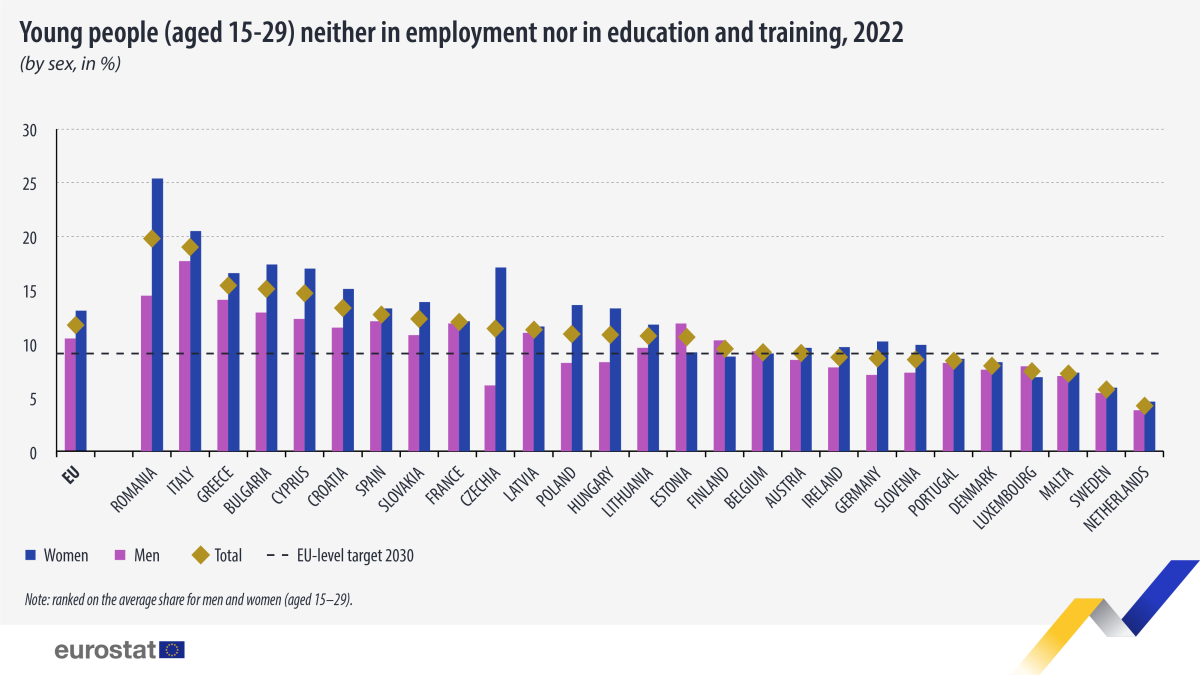
The reduction of this rate is one of the objectives of the European Pillar of Social Rights. The goal is to lower the rate of young NEETs aged 15-29 to 9 per cent in 2030. Among the EU countries, there are wide variations when looking at the NEET rates for the 15-29 age group in 2022. The proportion of NEETs in the EU ranged from 4.2 per cent in the Netherlands to almost 5 times higher in Romania (19.8 per cent). Romania is followed in the ranking by Italy.
The data show that, in 2022, one third of EU members were already below the 2030 target of 9, namely the Netherlands (4.2%), Sweden (5.7%), Malta (7.2%), Luxembourg (7.4%), Denmark (7.9%), Portugal (8.4%), Slovenia (8.5%), Germany (8.6%) and Ireland (8.7%).
In most EU members, there were differences between the shares of young female and male NEETs. In 2022, 13.1% of young women aged 15-29 in the EU were NEET, while the corresponding share among young men was 10.5%
The lowest NEET rates for young women and young men are both in the Netherlands: 3.8% for young men and 4.6% for young women. In contrast, the highest NEET rate for men was recorded in Italy (17.7%), with the highest for women recorded in Romania (25.4%). In four EU countries, the shares of young women NEETs were lower than the associated share of men: Luxembourg (6.9% women vs. 7.9% men), Finland (8.8% vs. 10.3%), Belgium (9.1% vs. 9.3%) and Estonia (9.2% vs. 11.9%).