On the eastern edge of Rome, a little-known route links a medieval village, a castle connected to the notorious Barberini family, and the ancient Latin city that once rivalled early Rome.
Part of the Unexpected Itineraries project, it brings together history, nature and architecture within just a few kilometres. Great for a day trip from Rome, these sites are all reachable by metro and bus.
Where to go: San Vittorino and ancient Gabii
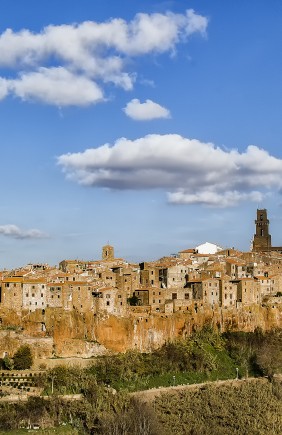
The route starts in San Vittorino, a small village balanced on a tuff ridge, its edges worn away over centuries to form two valleys below. The medieval street plan still follows an elliptical curve, wrapping tightly around the rock.
Within a few minutes’ stroll, you pass natural viewpoints and quiet landmarks: a three-spouted fountain, an unadorned church, and open views across the surrounding countryside that feel surprisingly remote for Rome.
Continuing along the old Via Prenestina, the landscape opens onto the Gabii Archaeological Park, where stretches of tuff fortification walls, sanctuaries and public spaces trace the outline of the ancient city that once rivalled — and influenced — early Rome.
How to get there
This itinerary is set up for public transport, with two straightforward routes linking central Rome to San Vittorino and Gabii.
- One option is to take the Metro B line to Ponte Mammolo, then continue by Cotral bus to the village.
- The other begins at Piazza San Giovanni, taking the Metro C line to Finocchio station, followed by a local bus to San Vittorino.
To reach the Gabii Archaeological Park, buses run along Via Prenestina Vecchia, stopping at Polense–Antica Gabii.
Bus 508 also departs from Ponte Mammolo, while buses 045, 055 and 107 connect from Finocchio to the stop near the entrance to the archaeological area.
Barberini Castle: emblems and traces of a noble past
One of the most atmospheric stops along the route is Barberini Castle, a 17th-century rural residence layered over earlier medieval foundations. Over the centuries, the estate changed hands several times:
- In the Middle Ages, it was left to the monastery, before passing to the Colonna and Del Drago families, and eventually to the powerful Barberini.
- In the 19th century, the Barberini played a key role in efforts to tackle the malaria that once blighted this stretch of countryside.
Later restorations altered much of its appearance, yet traces of its past are still visible. The square entrance tower, the rough tuff blocks on the façade, and the three bees of the Barberini coat of arms signal the lineage behind it.
Exploring the village of San Vittorino
Access to San Vittorino is free, and it’s the sort of place that rewards a slow wander. The village still follows its original elliptical layout, wrapped around a tuff ridge that rises above two carved valleys. In the centre, there’s a small three-spouted fountain inspired by Rome’s classic nasoni, though its base in local stone gives it a distinctly rural character.
A short stroll away stands the Church of San Vittorino, recognisable by its plain façade, simple portal and large rectangular window. Inside, a single nave with side chapels creates a restrained, almost intimate space, shaped as much by collective memory as by architecture.
Gabii Archaeological Park: what to see
Set along the old Via Praenestina, the Gabii Archaeological Park reveals the outline of a political and cultural centre that was thriving even before Rome fully emerged. Excavations have brought to light substantial engineering and architectural works, along with public spaces that point to Gabii’s standing within the ancient region.
As you walk the site, you move through monumental zones, traces of the ancient street grid and religious areas that offer glimpses into the Archaic and Republican periods. Everything is within easy walking distance, giving the visit a quiet, open-air museum feel without the crowds typical of central Rome.
Walls, sanctuaries and forum
Within a few steps, the route shifts from Gabii’s defensive walls to the sanctuary of Juno Gabina, once the religious and symbolic heart of the city. You then pass the public baths and the Regia, a reminder of the structured civic life and visible aristocracy that shaped ancient Gabii.
The tour culminates in the forum, formerly framed by porticoes and central to public life. Beyond it lie the Church of San Primitivo, where parts of the crypt have partially collapsed, and the eastern extra-urban sanctuary, reached by following the path outside the original city walls.
Worthwhile detours near San Vittorino and Gabii
If there’s time to linger a little longer, two nearby stops add a different perspective to the main San Vittorino and Gabii trip:
Mola Valley: a series of waterfalls sits beside an old mill and scattered historical remains. The path follows 22 arches, echoing the route of the Roman Anio Vetus aqueduct.
It reaches the Ponte di San Pietro, another reminder of Roman engineering still embedded in the landscape.
Sanctuary of Our Lady of Fatima: the church is built in reinforced concrete with four vaults and three large glass doors.
Inside, the circular hall and carefully arranged flooring and pews create an almost immersive spatial effect that contrasts sharply with the ancient sites nearby.
Stay inspired for your travels in Italy —get our weekly newsletter for the latest travel, legal, and lifestyle news.