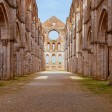
In the Val di Merse, southwest of Siena, an ancient abbey stands in open countryside with no roof above its Gothic nave. Stone walls, pointed windows and high arches remain, but clouds, sunlight and rain now pass through the space that was once enclosed by a church roof.
The abbey lies in the municipality of Chiusdino, surrounded by fields and woodland. Its roofless interior has become one of Tuscany’s most recognisable historic settings, although its present-day appearance comes after centuries of change rather than any original design choice.
A Cistercian abbey in the Val di Merse
The Abbey of San Galgano was built during the first decades of the 13th century. The Cistercian order moved down from the hill of Montesiepi to the plain, following a settlement pattern that favoured rural land with water and cultivable fields.
Its church was built on a large scale, with a central nave, two side aisles, a broad transept and pointed-arch windows. The plan was sober and spacious, reflecting the order’s architectural approach.
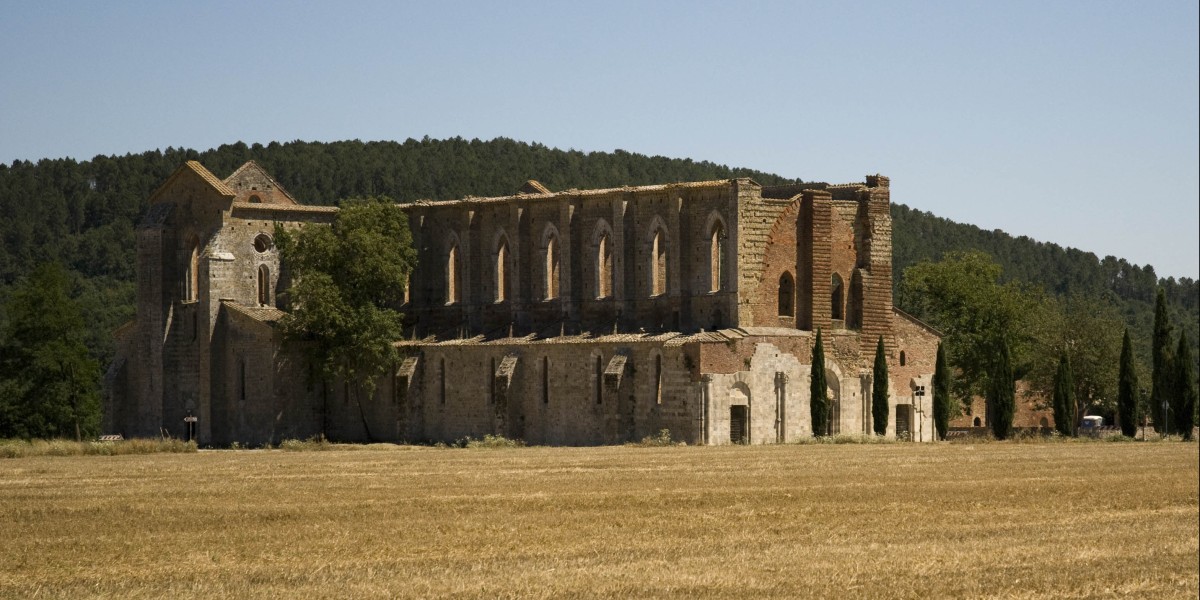
For centuries, the complex also played an active religious and economic role in the area, connected with Siena and the agricultural territory around the Val di Merse. Its current appearance developed later, particularly after the loss of the roof between the 18th and 19th centuries.
In places, grass now covers parts of the original floor. The arched openings frame the surrounding countryside instead of separating the church from it, while the roofless nave leaves the building exposed to changing weather and light.
The sword in the stone at Eremo di Montesiepi
A short distance uphill from the abbey is the Eremo di Montesiepi, the site linked to Galgano Guidotti. Inside the hermitage is a sword embedded in rock, associated with the knight’s conversion and his decision to renounce weapons.
The hilt and blade form the shape of a cross. The sword is now protected for conservation reasons, and studies of its metal have found it compatible with the medieval period.
Its presence inevitably recalls stories of Excalibur and King Arthur, but the comparison has limits. The source material places the Tuscan sword and the Arthurian tradition in separate historical and narrative contexts.
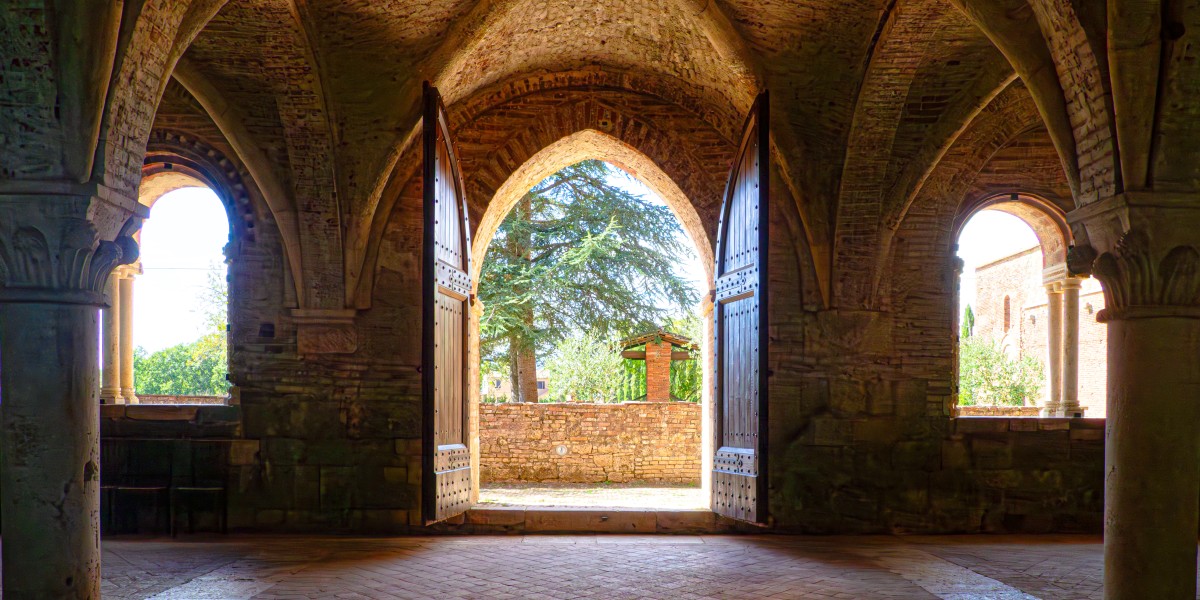
The hermitage has a circular ground plan, an uncommon feature in medieval churches, and contains frescoes and other traces connected with the cult of San Galgano. It was the spiritual centre associated with the saint before the large Cistercian abbey was built on the plain below.
Visiting San Galgano Abbey and Montesiepi
San Galgano Abbey and the Eremo di Montesiepi can be visited on the same day. They are separated by a few hundred metres, connected by a route that rises from the plain towards the hill.
Spring and autumn bring milder temperatures, while summer’s central hours can be particularly hot. With no roof at the abbey, there is little shelter from either strong sun or rain.
The nearby village of Chiusdino adds medieval streets, small trattorias and further connections with the story of San Galgano. For a slower route through the surrounding area, the Val di Merse can be explored by car or bicycle along provincial roads passing woods, cultivated fields and small villages.
Information in this piece is based on an Italian article by Fabio Belmonte, published on 1 October 2026