Italy’s luxury residential market is not merely holding steady; it is gaining pace. This is the picture set out in Knight Frank’s Italian Homes 2026 report, which monitors the country’s leading prime locations each year, including major cities, the lakes, Tuscany, Sardinia, Liguria and the Dolomites.
The market is being supported by rising international demand, a tax framework that remains competitive and a quality of life that continues to attract buyers worldwide.
- Milan leads growth, up 28% over three years with prices at €22,000 per m²
- A €1 million budget buys considerably more space than in London or Paris
- Rome, Florence and Tuscany: history, lifestyle and permanent relocation
- Lake Como is no longer only a second-home destination
- Venice, Liguria, Sardinia and Cortina: each market has its own story
- Flat tax draws wealthy buyers: more than 60% of super-prime enquiries are tax-led
Milan leads growth, up 28% over three years with prices at €22,000 per m²
Milan recorded the strongest growth, with prime values rising by around 28% over the three years to 2025. It was followed by Florence, up 18%, and Lake Como, up 15%.
In the Lombardy capital, luxury home prices rose from €17,270 per m² in 2022 to more than €22,000 per m² in 2025, an increase of almost 30% in three years. Since 2017, average asking prices have climbed by 50%.
There is little sign of this trend slowing. A shortage of high-quality homes continues to limit supply and keep values at elevated levels.
The most sought-after areas
Demand remains concentrated in established areas such as Brera, the Quadrilatero della Moda and Magenta.
International interest is also growing in more contemporary districts including Porta Nuova and CityLife, where architecture, services and the urban environment play an increasingly important role in buyer decisions.
Alongside period apartments and penthouses with terraces, modern homes with integrated services are gaining attention.
Milan now operates as a European capital market, with an increasingly selective buyer base and dynamics that are moving closer to those of London and Paris, although prices remain comparatively lower in absolute terms.
A €1 million budget buys considerably more space than in London or Paris
Value for money is one of Italian property’s strongest selling points internationally. With a €1 million budget, buyers can purchase between 79 and 89 m² of luxury housing in Rome and Florence.
In Venice and Lucca, this rises to between 126 and 130 m², a level of space that would be difficult to secure in Europe’s major capitals with the same investment.
Knight Frank places this comparative advantage at the centre of Italy’s position in the global luxury market.
Rome, Florence and Tuscany: history, lifestyle and permanent relocation
In Rome, demand is strongly lifestyle-led. The prime market remains closely tied to the limited availability of high-value historic properties and the difficulty of expanding supply because of planning and heritage protections.
International buyers, mainly from the United States, the United Kingdom, the Middle East and northern Europe, are searching for both second homes and primary residences. The historic centre sits alongside growing interest in areas such as the Appia Antica, where villas with gardens and larger homes appeal to buyers prioritising privacy and quality of life.
Florence continues to stand out for its balance of historic heritage, liveability and international outlook. The hillside areas of Bellosguardo and Pian dei Giullari are particularly sought after by buyers looking for greenery and views across the countryside, while Chianti broadens the choice with villas, estates and rural homes. On an annual basis, Florence recorded prime price growth of around 6% to 7%.
Across Tuscany, a meaningful change is taking shape. A growing share of international buyers are no longer looking only for a seasonal second home but are considering permanent relocation plans.
In the Val d’Orcia, country homes with views, land, vineyards and olive groves remain the most requested properties. There is also greater interest in restored homes in historic villages, which are easier to manage and ready to live in straight away.
Lucca is also becoming more established as a destination, with apartments in period buildings in the historic centre and villas in the surrounding hills. It benefits from its proximity to Versilia and Pisa Airport.
Lake Como is no longer only a second-home destination
Among the destinations changing most quickly is Lake Como, which, after 15% growth over three years, has moved beyond a purely tourism-led role. International families and professionals are increasingly choosing the area as a main residence, drawn by privacy, quality of life and its strategic position between Milan, Switzerland and the Alps, as well as its proximity to international airports.
Supply has also diversified. Historic pied dans l’eau villas, meaning villas with direct lake access, now sit alongside contemporary penthouses, detached houses and more compact pied-à-terre homes. This broader property choice has helped widen the pool of potential buyers.
Venice, Liguria, Sardinia and Cortina: each market has its own story
Venice remains a market where a property’s value is closely linked to location. San Marco, Rialto and Dorsoduro along the Grand Canal remain the most sought-after areas.
Cannaregio, Santa Croce and Castello are drawing more interest among people seeking a more residential setting, while Giudecca appeals to those looking for a quieter pace while staying close to the centre.
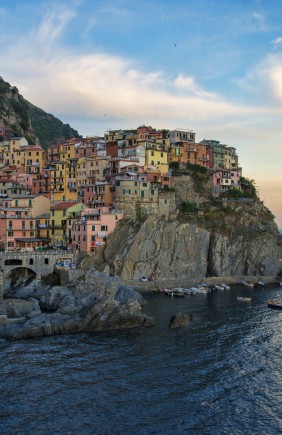
Liguria benefits from its mild climate and local life that remains active beyond the summer months, making it appealing to buyers seeking a home that can be used year-round. The completion of the high-capacity Terzo Valico rail link could further strengthen connections with northern Italy and the rest of Europe, expanding the potential buyer base.
In Costa Smeralda, housing stock remains limited due to architectural and environmental restrictions that have prevented new construction along roughly 20 km of coastline.
As a result, the market is focused almost entirely on the resale of existing villas. Premium apartments start at around €700,000 and villas at €2.5 million, while the average transaction value for villas is around €7 million.
Cortina d’Ampezzo is gradually moving beyond its seasonal role, helped by the international visibility of the Milan–Cortina 2026 Winter Olympics. The most sought-after homes are chalets, panoramic apartments and historic properties reworked in a contemporary style, with close attention paid to natural materials and their connection with the Dolomite setting.
Flat tax draws wealthy buyers: more than 60% of super-prime enquiries are tax-led
Italy’s market growth also reflects greater international mobility among wealthy individuals, accelerated by regulatory changes in other countries. Changes to the UK’s non-dom regime have led many high-net-worth individuals to reconsider their tax residency, with Italy becoming one of their preferred destinations.
The increase in Italy’s flat tax from €100,000 to €200,000, and then to €300,000, has not reduced interest. More than 60% of the international super-prime enquiries handled by Knight Frank are now primarily linked to tax considerations.
Domestic demand is also rising. Italy’s population of ultra-high-net-worth individuals grew by 23% between 2021 and 2026, compared with 12% in the United Kingdom. Over the next five years, the number of billionaires in Italy is expected to increase by 34%, reaching 82 by 2031.
The way buyers purchase property is changing too. Interest is growing in turnkey homes that have already been restored and are ready to move into, as well as properties that combine personal use, quality of life and rental income potential. Tuscany and Lake Como benefit from established tourism markets, while Milan and Rome can rely on steadier year-round demand.
In short, Italy’s luxury market is no longer selling homes alone. It is selling a way of life, and buyers around the world appear willing to pay for it.