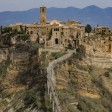
There is a point on the approach to Civita di Bagnoregio when the modern world rather abruptly falls away. A long pedestrian bridge crosses a deep valley towards a cluster of honey-coloured stone houses, seemingly detached from the rest of Lazio. At a distance it looks almost too neat to be real. Up close, the reason for its uneasy nickname becomes clear.
Known in Italy as la città che muore — the dying city — Civita sits on a tufa plateau that has been worn down by rain, wind and landslides for centuries. Its isolation is not a clever tourism slogan. It is the physical result of a landscape that has slowly eroded around it, taking parts of the original settlement with it.
The village, one of Italy's most beautiful, was once part of a larger community. Now, only a small number of permanent residents remain, while the old town can only be reached on foot.
Why Civita di Bagnoregio is called the dying city
Civita’s precarious setting has shaped almost every chapter of its past. The settlement stands on friable volcanic tufa, above layers of clay that become unstable after prolonged rain. Erosion has steadily narrowed the plateau, while landslides and earthquakes have altered the town’s footprint over generations.
The most devastating historical event was the 1695 earthquake, which caused serious damage in the area and contributed to the gradual abandonment of parts of the old settlement. Bagnoregio itself expanded on more stable ground nearby, while Civita became increasingly cut off.

Writer Bonaventura Tecchi, who was born in Bagnoregio, popularised the description la città che muore in the 20th century. It stuck because it captured more than the geology.
Civita had become a place with a fading residential population, a shrinking physical boundary and a bridge replacing the road that once connected it to the surrounding countryside. Yet its extraordinary setting still attracts attention, including reports that Harry Styles bought a house in Italy’s ‘dying city.
Its handful of residents also places Civita among the smallest villages and towns in Italy.
A village with Etruscan roots and a medieval silhouette
Civita’s story reaches back much further than its modern nickname. The Etruscans established a settlement here, taking advantage of the naturally defensive position above the valleys. Their presence can still be traced in the area, including the ancient access route and the nearby Etruscan sites around Bagnoregio and the broader Tuscia region.
Its present-day appearance is largely medieval, with stone lanes and centuries-old buildings that make it one of Italy’s most striking surviving medieval settlements.

Through Porta Santa Maria, the principal entrance, narrow lanes pass stone houses, modest piazzas, little gardens and views that open sharply across the Valle dei Calanchi. This heavily eroded badlands landscape is part of the drama: pale clay ridges, gullies and green folds shifting with the light.
The Church of San Donato, on Piazza San Donato, anchors the main square. Small details reward a slower wander: carved doorways, cats asleep on warm paving stones and the occasional vegetable patch improbably hanging on above the drop.
The bridge walk is part of the experience
There is no vehicle access to Civita di Bagnoregio for visitors. The final approach is a steep, roughly 300-metre pedestrian bridge from the Belvedere car park area in Bagnoregio, followed by a climb through the gate.
The pedestrian-only arrival also explains why Civita feels distinct from many Italian hill towns. No scooters squeeze through its lanes, no cars circle for parking, and deliveries must work around the bridge.

Visiting Civita di Bagnoregio in 2026
Civita di Bagnoregio is in the province of Viterbo, around 120 kilometres north of Rome. It is often paired with Orvieto, Viterbo or Bolsena, though public transport takes a bit of planning and a car remains the simplest option.
Visitors pay an access fee to enter Civita, collected at the gateway before the bridge. The system helps fund maintenance and conservation, but prices, opening hours and exemptions can change, so it is sensible to confirm the latest details through the Comune di Bagnoregio before setting off.
Staying near Civita di Bagnoregio
Civita itself has limited accommodation, and staying in Bagnoregio or nearby towns generally gives more choice, easier parking and a better sense of everyday life in northern Lazio.
Orvieto is a useful base for rail connections, while Bolsena suits anyone drawn to lakeside walks and longer stays. Civita also sits among Italy’s most beautiful small towns.
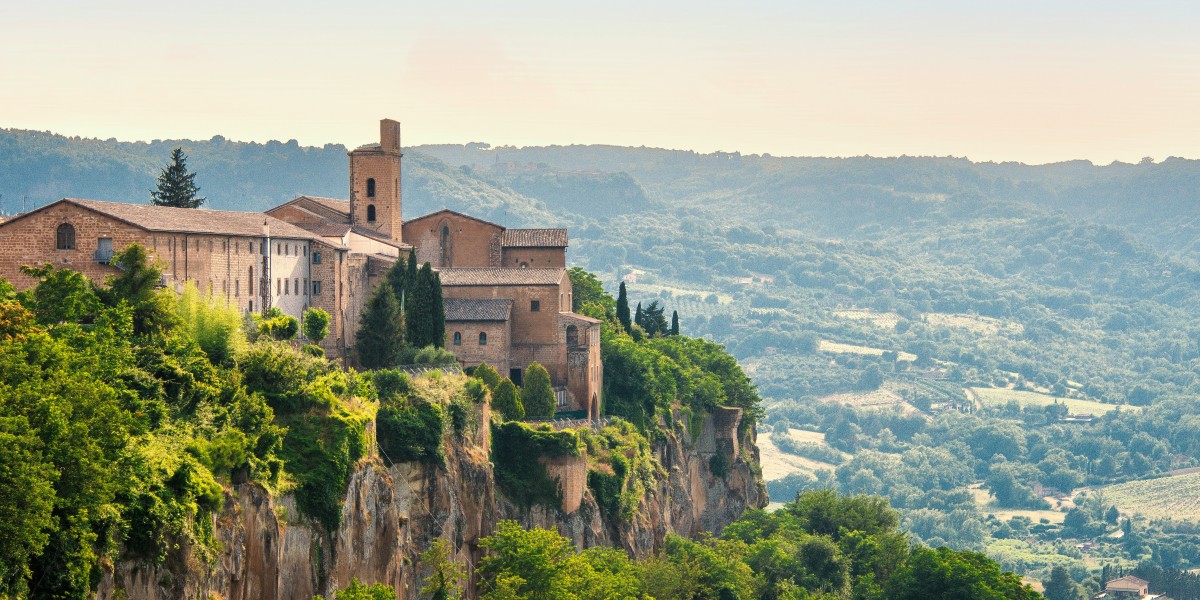
A night nearby changes the rhythm completely. Day visitors mostly arrive mid-morning and leave by late afternoon, leaving the lanes calmer and the views across the Valle dei Calanchi at their most otherworldly.
Stay inspired for your adventures in Italy —get our weekly newsletter for the latest travel, legal, and lifestyle news.